
The Legend of Daddy Hall makes music from an epic life and a neglected history
 iPhoto caption: Troy Adams image courtesy of Tarragon Theatre.
Tarragon Theatre’s final production of this season is the literal stuff of legends.
Come Home — The Legend of Daddy Hall, written by Audrey Dwyer and staged by Tarragon artistic director Mike Payette, pays tribute to the extraordinary life of John “Daddy” Hall. Hall, who was of mixed Mohawk and Black Jamaican ancestry, is thought to have been born near Amherstburg, Ontario in the 1780s. He died in Owen Sound over a century later — some say at the age of 117, others 118. (Hall being a legend, exact dates are hard to come by.)
In between, Hall fought as a Black loyalist in the War of 1812; survived capture by American forces and enslavement in Virginia and Kentucky; escaped slavery and returned north to Canada; took part in the 1837 Farmers’ Revolt against Upper Canada’s ruling class; and eventually settled in Owen Sound, where he became the town crier and the community’s first Black resident, and where he staved off ongoing attempts to steal his land. He also married up to six wives, and fathered up to 21 children. (Hence the epithet “Daddy.”)
If this epic life seems like a lot to pack into a night at the theatre, fear not. Dwyer, who was Tarragon’s 2018-19 Urjo Kareda artist-in-residence, has not crafted a linear, point-by-point biography. Come Home — The Legend of Daddy Hall, which premieres May 22 in Tarragon’s Mainspace, spirits audiences to an ancestral plane, where John Hall relives key moments in his life as a kaleidoscope of poetic text and music. Payette has called the piece an ancestral fantasia.
“It’s scary, but exciting,” said actor Troy Adams in an interview during the first day of technical rehearsals for the show.
Adams plays Billie, a present-day descendent of Daddy Hall and a new addition to the play, an earlier version of which debuted in 2021 as part of Tarragon’s Acoustic season. “Since we’ve started rehearsals, [we’ve] been workshopping the character of Billie,” said Adams. “At the beginning of the play, Billie finds himself disconnected from his ancestors. By the end of [the play], there is hope that he’s not lost. This reflects John [Hall’s] story: his journey is accepting his role as an ancestor, to be [Billie’s] guide.
“I’m getting very emotional,” Adams continued, describing Billie’s reckoning with his ancestral roots. Adams, who is from Halifax, is of Black Nova Scotian and Mi’kmaw ancestry. For him, The Legend of Daddy Hall is an opportunity to show how Black and Indigenous histories on Turtle Island — so often neglected in and of themselves — are in fact interwoven and interdependent.
“We’re resurfacing the history between Black and Indigenous communities in Canada and the U.S., and how connected we are,” Adams told me. “That history has [almost] totally been erased, whether it’s intentional or not. This resurfacing or exposing of this history is paramount to understanding who we are as Canadians: not just Black and Native people, but white people as well.”
Adams reflected on how Billie’s journey to connect with his ancestry resonates with his own. “To play Billie,” he said, “who’s asking a lot of the same questions that I’ve asked in my life and that I’m still asking, [is] very exciting.”
Adams is one member of a powerhouse cast that includes Indigenous actors Nicole Joy-Fraser (Tarragon’s My Sister’s Rage) and Brandon Oakes (CBC’s Diggstown), and Black actors Helen Belay (Soulpepper’s Queen Goneril and King Lear), Darren A. Herbert (CBC’s “Pretty Hard Cases”), and Emerjade Simms (Cahoots Theatre’s Sweeter, which also featured Herbert.)
“The environment [in rehearsal] is such a safe and non ego-based environment,” Adams shared. “I come to work and I’m like, ‘This is real. It’s not a glitch.’”
Those who have followed Adams’ work in productions like Djanet Sears’ The Adventures of a Black Girl in Search of God (a National Arts Centre co-production with Montreal’s Centaur Theatre, in association with Black Theatre Workshop) will know that he is an incredible vocalist and musician. Although this iteration of The Legend of Daddy Hall is not a musical, the creative team includes Dr. Spy Dénommé-Welch (Algonquin-Anishinaabe) and composer Catherine Magowan. The duo’s opera Canoe had its world premiere in Toronto last fall in a co-production between their company Unsettled Scores, Native Earth Performing Arts, The Toronto Consort, and Theatre Passe Muraille. Adams said that music still plays a key role in the piece.
“Billie has a leitmotif,” Adams explained. “There’s this musical line that is played, that you just know [represents] Billie. Each character is connected to a certain tone. The text is along the lines of poetry or spoken word, but it’s not delivered as such.”
Adams emphasized that the creative team is still deep in process: “We’re still exploring,” he confided. On day one of technical rehearsals, he and the other actors “were stepping onstage for the first time,” not only to play, but to honour an Afro-Indigenous legend through the power of music and theatre.
“It’s a vibrational movement that’s happening,” said Adams. “It’s a reclaiming.”
Come Home — the Legend of Daddy Hall runs May 14 until June 9 in the Tarragon Mainspace. You can purchase tickets here, or learn more about the show here.
Nathaniel Hanula-James
Nathaniel Hanula-James is a multidisciplinary theatre artist who has worked across Canada as a dramaturg, playwright, performer, and administrator.
LEARN MORE iPhoto caption: Clare Coulter in 'Queen Maeve.' Photo by Jae Yang.
Clare Coulter brings a lifetime of experience to Judith Thompson’s Queen Maeve at Tarragon
“This is the first stage play I've done in such a long time,” says Coulter, “but I feel I've really learned what the stage asks of the actor: that they go beyond what we used to call the footlights and settle in to where the audience is.”
 iPhoto caption: Natasha Mumba and Eric Miracle in 'Copperbelt.' Photo by Dahlia Katz.
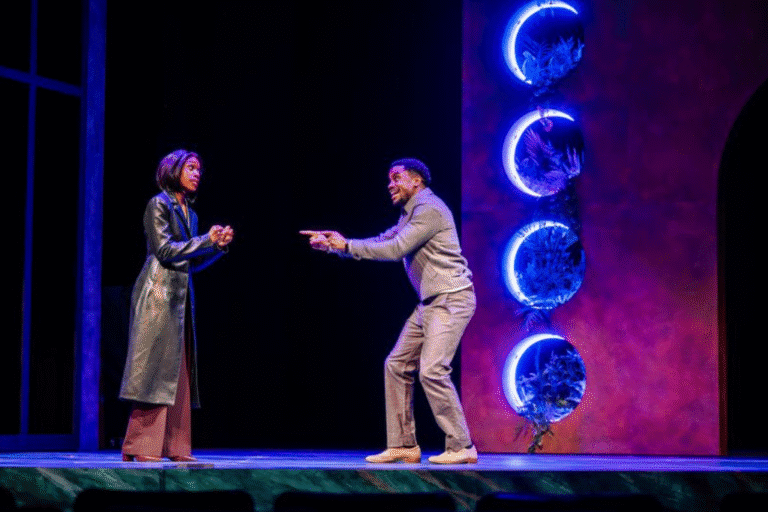
Copperbelt’s creative team crossed continents to do Natasha Mumba’s debut play justice
Zambian dialect coach Chiluba Katongo Nosfu worked with the cast, and also provided translation support for Mumba’s script: Copperbelt’s characters regularly interject words and phrases from Bemba — one of over 70 languages spoken in Zambia — into their English dialogue.
 iPhoto caption: Lester Trips duo headshot Lauren Gillis and Alaine Hutton. Photo by Helen Yung.
Lester Trips wants Toronto theatre creators to ‘make it nasty’
"It doesn’t matter how many reels of a hamster falling out of its cage set to the Requiem I see: The music still hits," says Lauren Gillis. "We joke that the logline for Honey I’m Home is 'normie drone has menty-b from VR Zoom with her own living room.'"
 iPhoto caption: Brendan Healy in rehearsal for 'A Doll's House.' Photo by Dahlia Katz.
Canadian Stage’s A Doll’s House marks the second entry in a trilogy of productions about marriage
“At 50, thinking about marriage and love, and [their] place in my life, I wanted to do an artistic deep-dive into the idea of partnership,” says director Brendan Healy.

Rhubarb! Festival director Ludmylla Reis wants artists to embrace ‘the detour’
"We do something formative at some point in the arts, and then we just continue doing that in different fonts until we’re no longer on this earth," says Reis. "The important thing is to know what that is, because you don’t want to be controlled by it. You want to be in control."
 iPhoto caption: Wing Chun Dance Drama, courtesy of Shenzhen Opera and Dance Theatre.
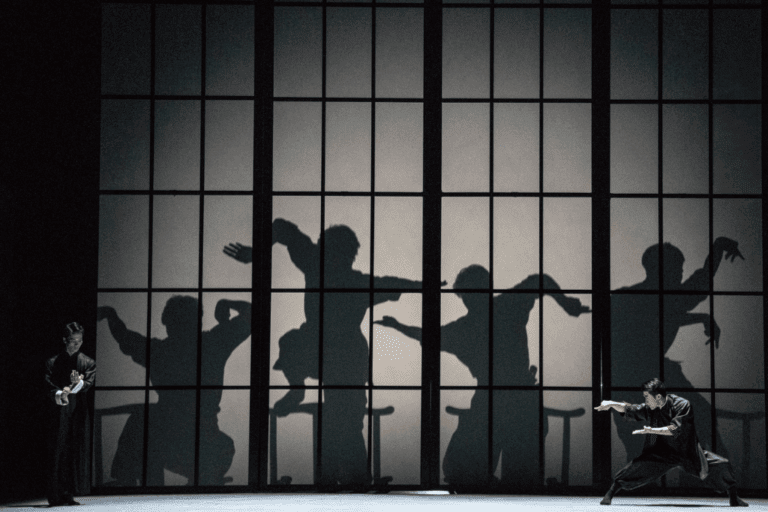
Wing Chun Dance Drama is a martial arts movie come to life
“In China — especially in the history of Chinese cinema — Ip Man is a household name,” said Han, in translated written responses to questions over email. Ip had a lasting influence on wing chun, a style of kung fu that originated in southern China over 300 years ago. In his 60s, he trained Bruce Lee, who would go on to become a famous performer in Hong Kong and American martial arts films.
Comments