
REVIEW: Exquisite Yiddish Fiddler on the Roof bursts with both elation and pain
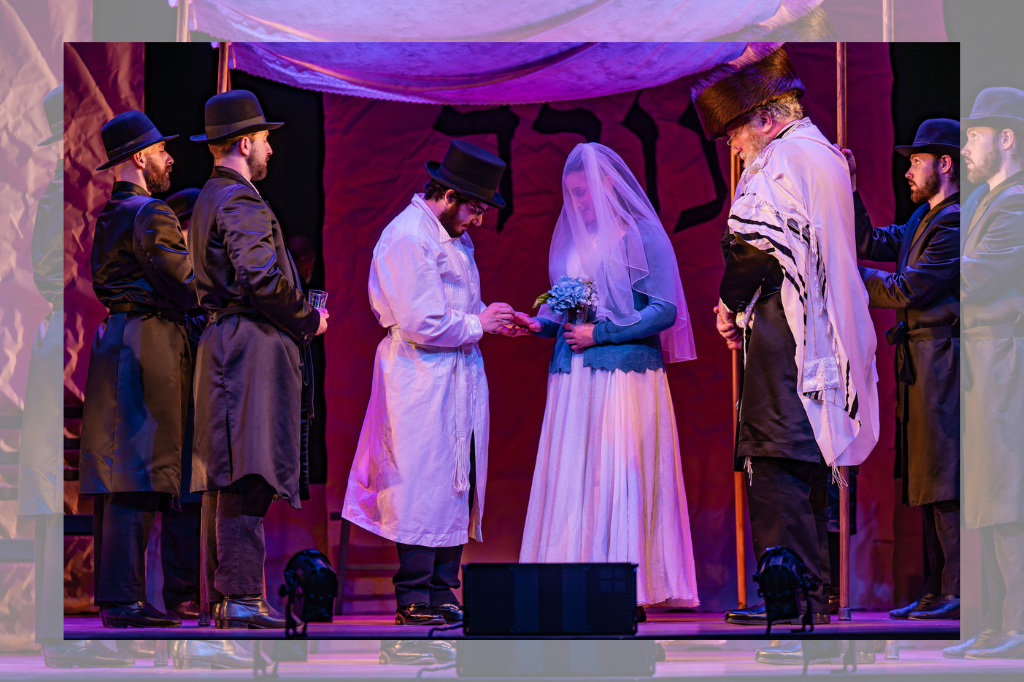 iPhoto caption: Members of the company of 'Fiddler on the Roof.' Photo by Dahlia Katz.
In Jewish life, happiness is scored in a minor key. Even in times of joy, there’s always a note of sorrow. It’s packed into our music, rituals, and revels: the need to temper celebration with remembrance of previous loss and persecution, to prepare ourselves for that cycle to begin again.
As Tevye (Steven Skybell) wryly notes in Harold Green Jewish Theatre Company’s exquisite rendition of the National Yiddish Theatre Folksbiene’s Fiddler on the Roof, maybe that’s why Orthodox Jews always wear their hats — to be able to face expulsion at a moment’s notice.
Director Joel Grey’s production of Jerry Bock, Sheldon Harnick, and Joseph Stein’s musical at the Elgin Theatre, in a 1964 Yiddish translation by Shraga Friedman with English and Russian surtitles, bursts with both elation and pain. Hearing the adaptation of Sholem Aleichem’s stories of Tevye the Dairyman in their original language adds to the show’s message of survival and adaptation in a sea of change.
Aleichem’s stories, written between 1894 and 1914, are set in the fictional Anatevke, a town in Imperial Russia’s Pale of Settlement. During this period, increasingly violent antisemitic pogroms triggered one of the major mass migrations of Jews from the region.
Two foundational tenets are important to Anatevke’s denizens — religion and tradition, the latter deriving from the former. Beowulf Boritt’s minimal scenic design represents the religion, a set of fabric backdrops that resemble wrinkled vellum pages of a well-loved holy book. The word “Torah” in Hebrew dominates centre stage, constantly illuminated and glowing like an eternal flame. The backdrop’s sanctification, desecration, and resurrection signifies the resilience and endurance of the people before it.
Tradition, or “Traditsye,” is the constant musical refrain, as Teyve’s five daughters test his adherence to his beliefs, gradually asking for larger concessions toward their autonomy in matters of love. Part everyman, part trickster, Tevye is the painfully human heart of Fiddler, and Skybell captures it all: Tevye’s desire to be stern and preserve the patriarchy; his ironic, searching conversations with God; his need to save face in the village; his deep and abiding love for his daughters that pushes aside his pride.
Skybell puffs up with affronted self-importance before deflating quickly into resigned acceptance when faced with questions of his children’s happiness. He delivers a solemn prayer over an infant’s head, immediately following the words with an adorable game of peekaboo. He moves a stanchion aside to allow mixed-gender dancing at a wedding, cracking and expanding beneath the weight of new ideas. When he’s finally confronted with a bridge too far, his resulting shutdown is heartbreaking — we’ve come to see him as a kind, affable tree that bends in the wind.
He’s joined by a terrific Canadian cast. Tracy Michalidis captures Tevye’s wife Golde’s world-weariness and wonder at even the thought of love and choice. As daughters Tsaytl, Hodl, and Khave, the actors Isidora Kecman, Emma Burke-Kleinman, and Alice Malakhov ring like feisty bells, finding chemistry with childhood sweetheart Motl (a charmingly anxious Joshua Kilimnik), fiery student agitator Pertshik (Sayer Roberts), and Russian Orthodox farmer Fyedke (Nick Boegel) respectively, while growing increasingly perturbed by the attentions of matchmaker Yente (a delightfully overbearing Theresa Tova).
Igor Portnoi adds menace and relevance as the Russian constable who claims he has nothing to do with the violent orders he receives, but will carry them out anyway after warning Tevye. He likes Tevye, despite his unfortunate Jewishness, because Tevye always greets misfortune with a little joke.
Grey and choreographer Staś Kmieć make creative use of dance to show character relationships. The townspeople’s elaborate opening hora, danced hand in hand, returns broken in the second act as they stretch out, unable to touch each other, torn apart. In a scene where Russian soldiers and Jews drink together in celebration, Tevye is wary. Skybell deliberately moves out of step with his newfound compatriots, clapping slightly off beat to show his fear of the danger they normally offer. But the two sides gradually come together, dancing with fluid complexity in a genuine cross-cultural exchange that’s sadly all too brief.
Fans of original choreographer Jerome Robbins’ famous bottle dance, where male cast members balance the vessels on their heads, will likely be pleased. And Tevye’s wild invented dream sequence to prevent a wedding, featuring shadows of guests and a bitter, eight-foot-tall late wife (a cackling Gabi Epstein) haunting the stage, is gleeful madness.
The surtitles are unobtrusive, almost disappearing via the actors’ communicativeness. Other than a few notable changes such as restoring Aleichem’s “If I were a Rothschild” for the first line of Tevye’s “If I Were a Rich Man,” they reproduce the musical’s book and lyrics. Yiddish speakers and those reading Russian captions will notice some important untranslated idioms, such as the Yiddish term bashert, meaning destiny or soulmate, in idealistic Pertshik’s love song.
In one stunning number, “Sabbath Prayer,” candles light up across the stage as each of the town’s households sing of their hopes for their daughters. The words are full of happiness and peace; the tune, a mournful cry.
It’s that combination that makes Fiddler as enduring as the community it represents.
Hope, in a minor key.
Fiddler on the Roof runs at the Elgin Theatre until June 7. More information is available here.
Intermission reviews are independent and unrelated to Intermission’s partnered content. Learn more about Intermission’s partnership model here.

Ilana Lucas
Ilana Lucas is a professor of English in Centennial College’s School of Advancement. She is the President of the Canadian Theatre Critics Association. She holds a BA in English and Theatre from Princeton University, an MFA in Dramaturgy and Script Development from Columbia University, and serves as Princeton’s Alumni Schools Committee Chair for Western Ontario. She has written for Brit+Co, Mooney on Theatre, and BroadwayWorld Toronto. Her most recent play, Let’s Talk, won the 2019 Toronto Fringe Festival’s 24-Hour Playwriting Contest. She has a deep and abiding love of musical theatre, and considers her year working for the estate of Tony winners Phyllis Newman and Adolph Green one of her most treasured memories.
LEARN MOREComments
Leave a Comment
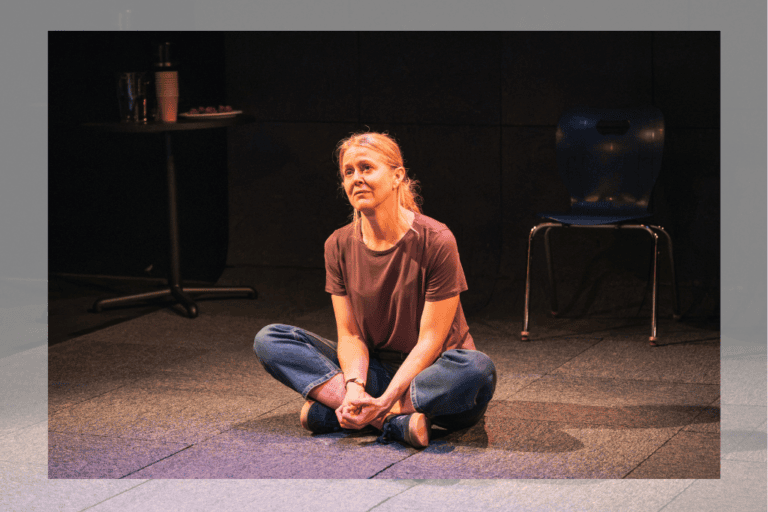 iPhoto caption: Amy Rutherford in 'Pre-Existing Condition.' Photo by Elana Emer.
In an attempt to create an issue-based work with a central everywoman, the play sends the message that we shouldn’t allow domestic violence to define a person while simultaneously staging that definition.
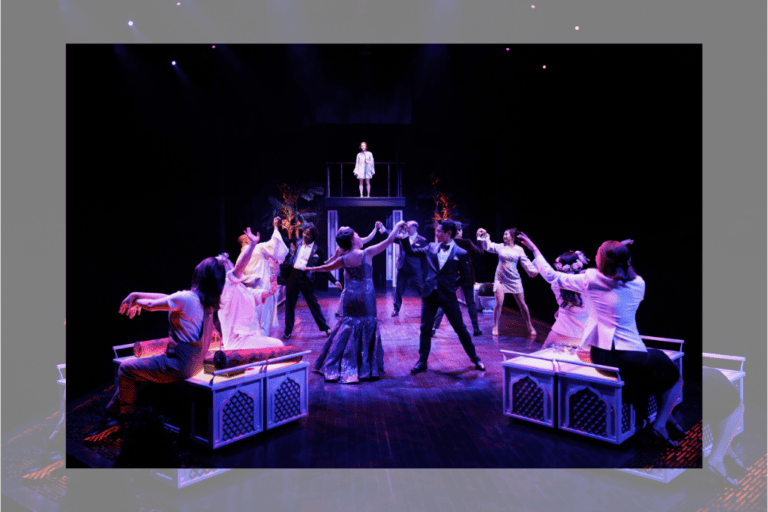 iPhoto caption: Members of the company in 'The Tao of the World.' Stratford Festival 2026. Photo by David Hou.
Set in an opulent world of Singaporean elites, writer-director Jovanni Sy 施崇梵’s world premiere work at the Tom Patterson Theatre is a bubbly, Crazy Rich Asians-style romcom that sweetens the palate before releasing a poignant pop of acidic social commentary, arguing that the concept of restoration is laughable to those who suffered most in the interim and returned to a status quo little better than the disruption.
 iPhoto caption: André Sills and Krystin Pellerin in 'Othello.' Photo by David Hou.
REVIEW: In The Tempest and Othello, the Stratford Festival gets vengeful — and it rocks
The two strong productions, seen as a double bill, make a compelling case against choosing vengeance, with director Haysam Kadri’s Othello an especially riveting and taut interpretation.
 iPhoto caption: Sara Farb and Qasim Khan in 'Funny Girl.' Photo by David Cooper.
REVIEW: Sara Farb shines in Funny Girl at the Shaw Festival
One theme of Funny Girl is acceptance of the self despite its flaws and inconsistencies. The musical, likewise, is full of flaws and inconsistencies, but compelling all the same. Luckily, Sara Farb as Fanny Brice in all her boastful vulnerability gives us that central figure who delights — an umbrella to ward off the rain.
 iPhoto caption: Raymond Strachan and Tom McCamus in 'Death of a Salesman.' Photo by David Hou.
REVIEW: Stratford Festival’s Death of a Salesman is stark and melancholy
The relatively straightforward production is aesthetically austere, but strong central performances of the family at its core keep it human.
 iPhoto caption: Daniel Maslany and Karl Ang in 'The Division.' Photo by Dahlia Katz.
REVIEW: Andrew Kushnir’s The Division confronts the impossibility of fully knowing the past
Playing at Crow’s Theatre, The Division is a thorny, intimate work of theatre that examines inherited guilt, the relentlessness of eye-for-an-eye justice, and the seductive promise of being able to clearly define and banish evil forever, if only you could choose and label the correct side.
Beautifully evocative writing from Ms. Lucas. Her reviews bring us into the experience of what it was like to be in the theatre – instead of plot-spoiling.