
REVIEW: The Green Line unspools an exquisitely written narrative of love and loss in Beirut
 iPhoto caption: Waseem Alzer in 'The Green Line'. Photo by Jeremy Mimnagh.
Tearing Beirut in half, the Green Line divided Muslims and Christians during Lebanon’s Civil War. Playwright-director Makram Ayache’s The Green Line opens by describing this “no-man’s land” as an imaginary place — a political concept that materialized in the vegetation that reclaimed the land. For Ayache, the Green Line becomes a site of reckoning, remembrance, and restitution.
It’s 1978. Mona (Zaynna Khalife), living with her brother Naseeb (Oshen Aoun) in the aftermath of their Mama and Baba’s death, is studying to be an engineer: she wants to build houses. When she meets Yara (Basma Baydoun), a female classmate at university, her world shifts. She’s in love.
It’s also 2018. A Canadian, Rami (Oshen Aoun), walks into a Lebanese gay bar. He meets a drag performer named Zidan (Waseem Alzer). Their encounter might be fate.
The Green Line explores what falling in love is like during war, for someone like Yara, who has known violence and loss, and for someone like Mona, who hasn’t — until now. And it specifically explores queer love. Rami starts his search for Arab identity in the place he feels most at ease: a gay nightclub.
But I won’t reveal too much. The Green Line takes a kaleidoscopic approach to storytelling. Scenes jump between storylines, with poetic addresses to the audience intercepting. “I heard you speak at my funeral, Rami,” Aoun declares early on. It’s not clear until much later which character speaks these words, and what he means. Motifs like the phoenix — both a necklace worn by Mona, and Zidan’s drag persona, Fifi — offer a placeholder logic until the narrative comes into focus. This methodology requires trust in the audience. There’s no handholding to interrupt the process of discovery, an enjoyable risk that ultimately pays off.
Stunning, conceptual set design (Anahita Dehbonehie) facilitates easy movement between stories. The world is literally off-kilter, with a tilted platform reflecting life in 1978 Beirut, stones on its periphery conjuring the destruction of homes both physical and metaphorical. Scenes set in 2018 play out in the rubble, a texture of trauma. Later in the play, the space opens up, a few times incorporating metal catwalks that run the edge of the theatre.
Complementing this set, the surtitle system (designed by Christopher-Elizabeth and operated by Dina Saleem) integrates seamlessly into the production, with a visual design that combines text and photo, as well as English and Arabic (translation by Hiba Sleiman). Sometimes, an ekphrastic phrase accompanies a silent scene: Yara’s wedding, for instance, is described as a haunting. The effect emphasizes Ayache’s exquisite writing: if you purchase a copy of the play (for sale in the Buddies in Bad Times lobby), you may, like me, become anxious that there is too much richness in this text to catch in a single viewing — even a single production.
Ayache displays striking care and understanding for each character, even Naseeb, who wants to leave Beirut for the mountains and take Mona with him. Mona is courageous in her desperation to maintain independence, an emotional yet buoyant performance from Khalife. But we also see Naseeb forced to patrol the streets with a machine gun, a foreign weight in his arms. He’s never shot a gun before, he tells us. The only double-cast actor, Aoun’s sensitive performance anchors the story and fosters understanding for the pressure growing within Naseeb. It’s the kind of pressure that erupts through the valves of misogyny and homophobia and violence.
The timing is right. Perhaps it always has been. In his director’s note, Ayache writes the following: “This play is not about explaining Lebanon or explaining queerness. It is about experiencing the complexity of love and memory through characters whose bodies bear the weight of politics, history, and desire.” The Green Line addresses coming to the content as an outsider, as someone whose body bears this weight differently. Rami’s late father has repressed their family connection to Beirut, warning Rami never to visit. He missteps, at times, in his engagement with the city’s traumas as a Canadian visitor, and Fifi corrects him with humour and edge. I’m an outsider too, not occupying the identities at this heart of this play. The Green Line centres those identities and experiences, and does not contort itself for an outsider’s eye. For the creative team to share this story represents an act of great generosity.
The Green Line runs at Buddies in Bad Times Theatre until October 4. More information is available here.
Intermission reviews are independent and unrelated to Intermission’s partnered content. Learn more about Intermission’s partnership model here.

Ferron Delcy
Ferron Delcy is pursuing her PhD in early modern literature at the University of Toronto. In 2024, Ferron participated in the New Young Reviewers program facilitated by Toronto Fringe and Intermission. She is a big fan of ghost stories, fog machines, and weird metaphors.
LEARN MORE iPhoto caption: William Ellis and members of the company of 'The Herald. Photo by Albert Hoang.
REVIEW: Jill Connell’s The Herald has a lot to say about potential
There’s so much to love about this smart, strange, and achingly lyrical exploration of labour and purpose. Dramaturgical intentionality falters, however, in the details.
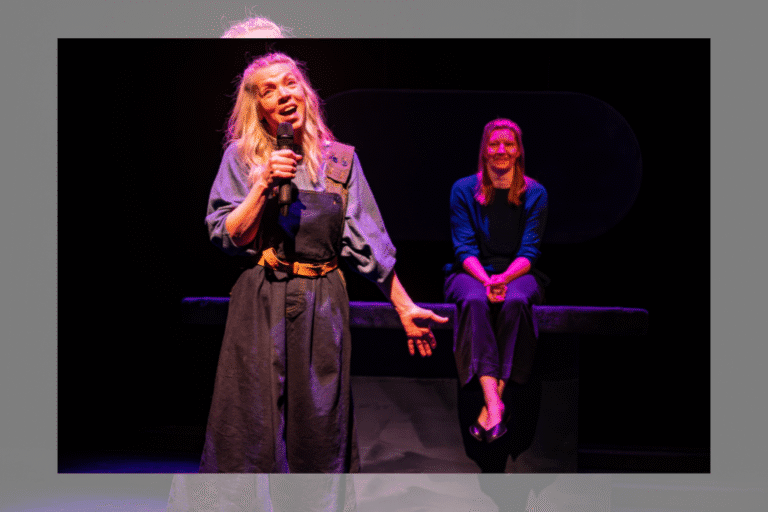 iPhoto caption: Liisa Repo-Martell and Maev Beaty in 'You, Always.' Photo by Dahlia Katz.
REVIEW: In You, Always at Canadian Stage, playfulness meets unabashed emotional vulnerability
This big-hearted play will steal your favourite going-out shirt, holler your crush’s name at full volume, and then accost you with a bear hug — all the while harboring a deep well of love and resentment.
 iPhoto caption: Photo courtesy of Minmar Gaslight.
REVIEW: A Question of Character examines the psychology of a filmmaker who created Nazi propaganda
The greatest strength of A Question of Character, now playing at the Aki Studio, is that its fundamental questions manifest as an active process. Rather than conveying a pre-packaged conclusion, the production undertakes a genuine attempt to work through Leni Riefenstahl's contradictions while weighing the payoffs of revenge.
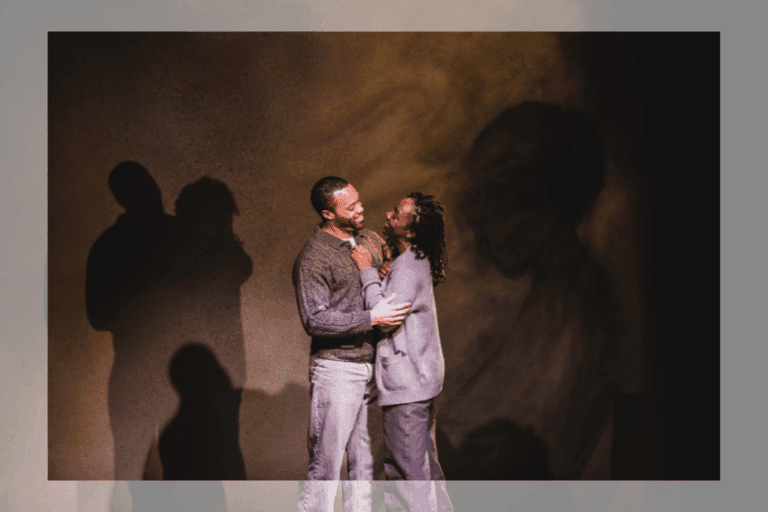 iPhoto caption: Dwain Murphy and Virgilia Griffith in 'a profoundly affectionate, passionate devotion to someone
(-noun).' Photo by Jae Yang.
iPhoto caption: Dwain Murphy and Virgilia Griffith in 'a profoundly affectionate, passionate devotion to someone
(-noun).' Photo by Jae Yang.
REVIEW: Obsidian and Tarragon co-production reflects on the inadequacy of language
a profoundly affectionate, passionate devotion to someone (-noun): the title says it all, offering a definition for an absent word. The thing is the thing unsaid. For the play’s three couples, language falls short: beautifully, tragically, sublimely.
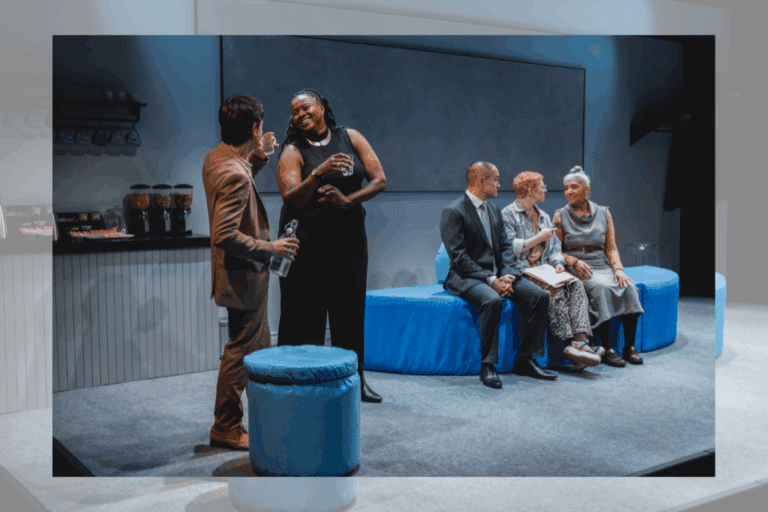 iPhoto caption: The company of 'CHILD-ish.' Photo by Jae Yang.
REVIEW: Tarragon’s CHILD-ish takes a hopeful and hilarious look at life through kids’ eyes
It’s a giggly good time, if a pinch oversweet.
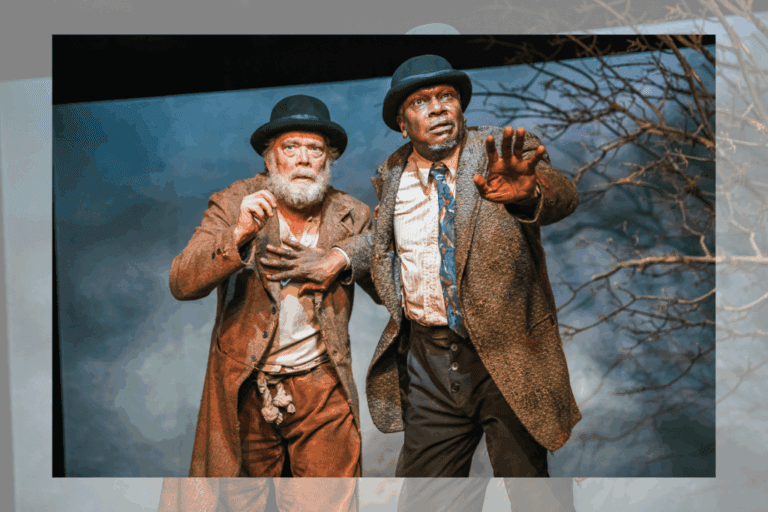 iPhoto caption: Ted Dykstra and Alexander Thomas in 'Waiting for Godot.' Photo by Elana Emer.
REVIEW: Coal Mine Theatre’s Waiting for Godot is lucid and unpretentious
Directed by Kelli Fox, this Waiting for Godot embraces the bodily sensibilities of Beckett’s dark humour, grounding his abstract poetics in the kidneys, the feet, and the dirt.
Comments