
REVIEW: In You, Always at Canadian Stage, playfulness meets unabashed emotional vulnerability
 iPhoto caption: Liisa Repo-Martell and Maev Beaty in 'You, Always.' Photo by Dahlia Katz.
Erin Shields’ new work You, Always, directed by Andrea Donaldson, embraces the tenderness and frustration of sisterhood. This big-hearted play will steal your favourite going-out shirt, holler your crush’s name at full volume, and then accost you with a bear hug — all the while harboring a deep well of love and resentment.
Leapfrogging through memories shared by Liz (Maev Beaty) and Delia (Liisa Repo-Martell), You, Always springs from bedtime bath routines to pregnancy announcements to games of make-believe across its taut 90-minute runtime. An argument between steady, conventional Liz and erratic, artistic Delia jumpstarts the show and repeats at intervals, adding material each time until the scenes play out in full. Once all is disclosed, the source of the argument isn’t truly a surprise (it seemed clear to me where the plot was headed), but that didn’t prevent my tears in the final moments.
While I entered the theatre wary of an overly sentimental meditation on familial love, I was won over by the play’s spirit of curiosity and formal innovation, alongside its unabashed emotional vulnerability. I never felt the play used sensationalized subject matter to solicit audience emotion. (Name a sister without an eating disorder, or a family who hasn’t experienced a frightening cancer diagnosis.) What matters to this story is how it feels when a close relationship encounters these points of intensity.
Last fall, Donaldson directed CHILD-ish at Tarragon Theatre, a piece of verbatim theatre that featured adult actors playing children. In You, Always at Canadian Stage, Donaldson again offers a vision of childhood that takes kids seriously, aided by Shields’ sharp writing and grounded performances from Beaty and Repo-Martell. Not every scene is set in Liz and Delia’s childhood years, but I found the ones that were among the most affecting in the show. Highlights include a painstakingly choreographed dance to “Love is Strange” by Mickey and Sylvia, complete with the lover boy crawl from Dirty Dancing. Beaty and Repo-Martell perform the routine with requisite concentration and stiffness. This early vignette was the first that defined the sisters’ complicated intimacy for me, as echoed in the lyrics of the song: love is strange.
Another standout: a series of scenes in which the girls play pretend, or rather, linger in an extended stage of planning the pretend game they will play. Shields picks up on the charming selfishness of children as Liz and Delia cheerfully counter each other’s suggestions with “no, but” and “that’s not how it goes.” In a running gag, Delia insists, more than once: “I’m a mermaid.” The motif of their game transforms into something even grander and more enchanting by the end of the play. It’s a delight I won’t spoil but through which the story’s themes of loyalty and courage are refracted.
Despite its fragmentated structure, You, Always never feels like it’s holding its subject matter at an emotional distance — I was totally immersed. Movement between each vignette appears effortless, supported by clever blocking that links the actors’ physicality from scene to scene. Lighting design by André du Toit distinguishes between moments in time, with the present coded in stark white. And versatile set design by Ting-Huan 挺歡 Christine Urquhart carves out a minimalistic playground in the Berkeley Street Theatre, with a multi-use curved mound, bathtub-shaped indent, and island centerpiece. Beaty and Repo-Martell transform this neutral space into tactile sites of nostalgia (I could absolutely see the beanbag chair Beaty lounges on as Liz and Delia bicker over after-school Oprah viewings). A fur of grey carpeting over everything contributes to the memory work, evoking ‘80s/’90s suburbia.
The story maintains steady momentum even without chronicity. Rather than being pulled along by a string of plot, Liz and Delia have their memories wrapped around them, growing more dimensional as the play progresses. At one point, Shields stages an impactful temporal collision, with each sister simultaneously performing different scenes, one in the present, one in the past. Such an approach to storytelling evokes Virginia Woolf’s prose experiments with subjective time. Liz and Delia experience their sisterhood as all of these moments and memories at once.
I do have one quibble. This paragraph will include a spoiler for the play’s reveal. Anyone who has seen a loved one die of end-stage cancer knows about the transformation that prohibits the kind of vivacity, eloquence, and creative spirit that person has carried with them throughout their life. “This is not good time,” Liz erupts, and I know exactly what she means. But seeing Beaty’s physical strength and ferociousness throughout this argument, I could also understand her sister’s confusion. Liz is so very alive.
That said, Beaty’s vibrancy is such a pleasure to watch, I wouldn’t wish to dim it. She shares an undeniable chemistry with Repo-Martell, who delivers her own deeply realized exploration of fear sheathed in rebellion. The pair embodies the heart of siblinghood: a grudgingly constant love.
You, Always runs at the Berkeley Street Theatre until February 22. More information is available here.
Intermission reviews are independent and unrelated to Intermission’s partnered content. Learn more about Intermission’s partnership model here.

Ferron Delcy
Ferron Delcy is pursuing her PhD in early modern literature at the University of Toronto. In 2024, Ferron participated in the New Young Reviewers program facilitated by Toronto Fringe and Intermission. She is a big fan of ghost stories, fog machines, and weird metaphors.
LEARN MORE iPhoto caption: Georgia Findlay in 'Northanger Abbey.' Photo by Raph Nogal.
REVIEW: GFT’s Northanger Abbey embodies the delights and absurdities of Gothic fiction
Handwringing over popular fiction is hardly a thing of the past, as present panic about Romantasy attests. Unsurprisingly, both genres have a reputation for attracting women readers. Tyler J. Seguin’s Northanger Abbey displays how legitimate literary criticism can devolve into worrying that women are having too much fun.
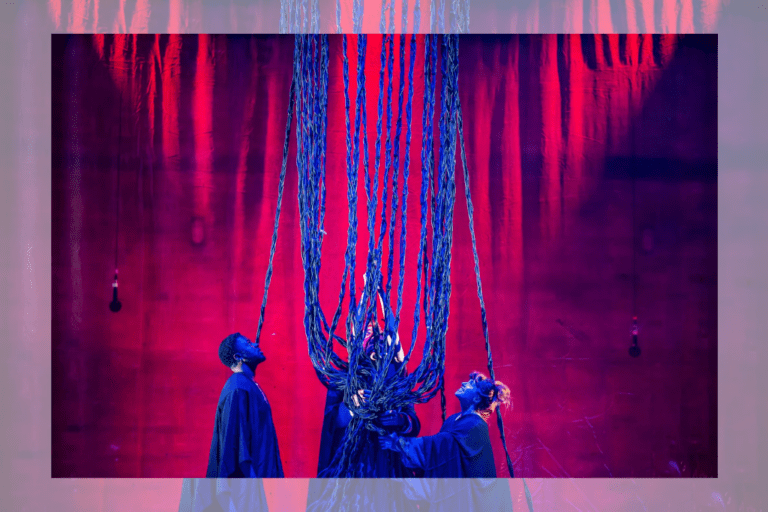 iPhoto caption: Members of the company of 'Medusa.' Photo by Dahlia Katz.
REVIEW: Soulpepper’s Medusa creates a mess it refuses to tidy
Speaking in sibilant murmurs via headsets wired into each seat of the Baillie Theatre, a chorus of intimate voices infiltrates the audience experience, drowning out dialogue and weaving an overstimulating soundscape.
 iPhoto caption: Paul Gross and Tom McCamus in 'Waiting for Godot.' Photo by David Hou.
REVIEW: Stratford Festival’s Waiting for Godot never feels fully its own
Tom McCamus' and Paul Gross' performances are clear and intentional. Nonetheless, I struggled to connect with this production.
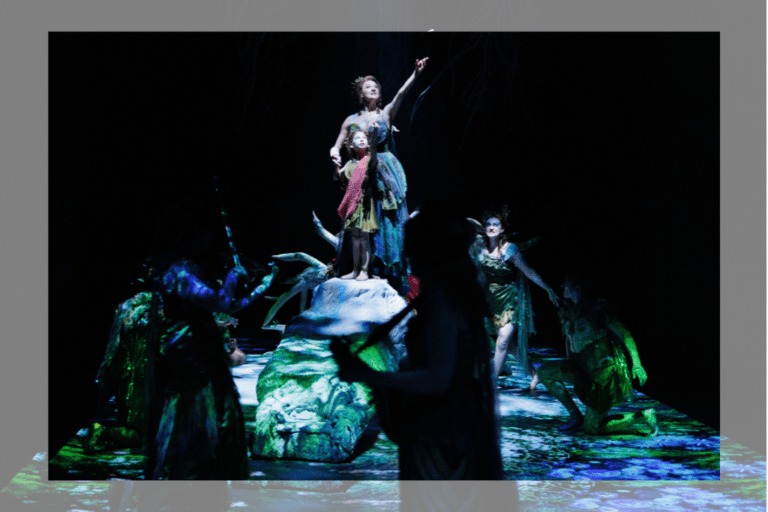 iPhoto caption: Members of the company of 'A Midsummer Night's Dream.' Photo by David Hou.
Developed in collaboration with Groundling Theatre, this A Midsummer Night’s Dream revels in the plights of its love-drugged protagonists through clever clowning, live music, and an animated landscape.
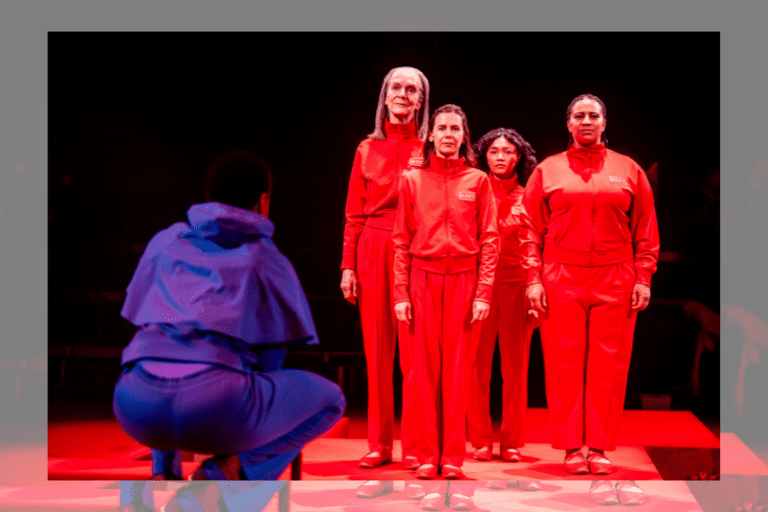 iPhoto caption: Amaka Umeh, Nancy Palk, Michelle Monteith, Belinda Corpuz, and Sabryn Rock in 'Mary, Mary, Mary, Mary.' Photo by Dahlia Katz.
REVIEW: Erin Shields’ Mary, Mary, Mary, Mary is brash, funny, and message-forward
At Crow’s Theatre, Mary, Mary, Mary, Mary is a sensory feast fit for any house of worship. But with so much material, and only 95 minutes, I’m left feeling that the Marys have more yet to say.
 iPhoto caption: William Ellis and members of the company of 'The Herald. Photo by Albert Hoang.
REVIEW: Jill Connell’s The Herald has a lot to say about potential
There’s so much to love about this smart, strange, and achingly lyrical exploration of labour and purpose. Dramaturgical intentionality falters, however, in the details.
Comments