
REVIEW: Stratford Festival’s A Midsummer Night’s Dream features rock-solid comedy and unexpected tenderness
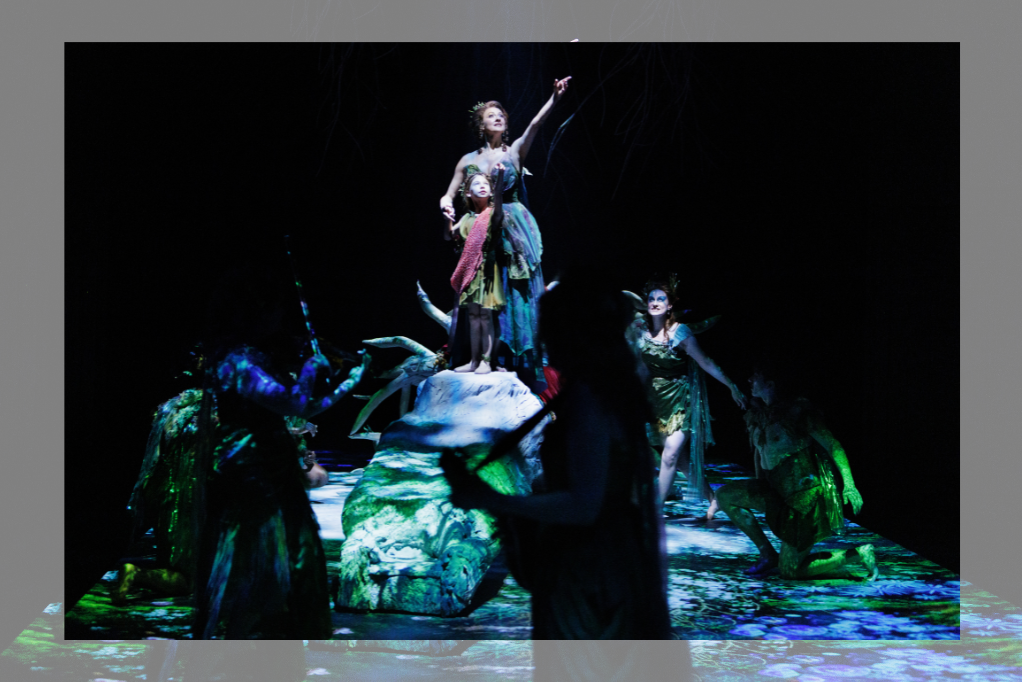 iPhoto caption: Members of the company of 'A Midsummer Night's Dream.' Photo by David Hou.
Love is pantingly, whiningly, brayingly embarrassing in the Stratford Festival’s 2026 A Midsummer Night’s Dream at the Tom Patterson Theatre. Developed in collaboration with Groundling Theatre, this production revels in the plights of its love-drugged protagonists through clever clowning, live music, and an animated landscape. Equally delightful are its glimmers of unexpected tenderness.
Midsummer is one of Shakespeare’s earlier plays. It combines classical Ovidian tropes and English folk customs. The resulting world is charmingly off-kilter — honey-bags, moonshine, and apricocks cut with groveling lovesickness and an alarmingly patriarchal death penalty. Its rhyming couplets are sickly sweet. Its principal joke pairs a queen with a donkey.
In its afterlife, Midsummer especially captured the imagination of the Victorians, combining their adoration of Shakespeare with their love of fairies. Director Graham Abbey appears to tap into this legacy, costuming his mortals in stunning 19th-century garb (design by Joshua Quinlan), a rigidly silhouetted style that contrasts the feral fashions of the fairy folk.
Sumptuous sound and set design further realize the eerie beauty of this green world. Thomas Ryder Payne’s Celtic-inflected soundscape features Laura Condlln, who plays the First Fairy, on viola and Dominique LeBlanc, who plays the fairy Nightingale, on violin and mandolin. Lorenzo Savoini’s set makes liberal use of trapdoors and Normal Studio’s video illusions transform the stage into a rushing river, as Titania (Sara Topham) enters aboard a momentous drifting bark.
The plot, if you need a refresher, is as follows: Hermia (Vivien Endicott-Douglas) and Lysander (Jordin Hall) love each other, Demetrius (Thomas Duplessie) loves Hermia, Helena (Jessica B. Hill) loves Demetrius. Finding themselves deep in the woods — realm of feuding fairy monarchs Titania and Oberon (André Sills) — the lovers fall victim to the trickster Puck, who further scrambles their love quadrangle. And there’s a subplot that turns amateur actor Nick Bottom (Michael Spencer-Davis) into a donkey.
This production stages a faithful yet effective portrayal of the lovers’ plot. Most of its innovations relate to the fairy world: adding an opening scene depicting the providence of Titania’s changeling child (Vivienne Abbey / Alexandra Krohn), innovating Titania’s spectacular entrance, as mentioned above, on a boat that later doubles as her tree-trunk bed, and including a post-intermission sequence between Puck and the changeling.
As a teen, I took issue with the deus ex machina of the play’s ending, in which Puck frees every character but Demetrius from the love spell. Sure, they end up together, but he doesn’t really love Helena! Abbey’s Midsummer doesn’t square this discord, but explores how love, drugged or not, is an experience beyond our control.
Helena’s desire for Demetrius sits at the heart of this play’s thesis on love’s all-consuming effects. Hill’s performance is remarkable, at once deeply grounded in the intricacies of Shakespeare’s language while taking “I am your spaniel” to its most comedic extremes. This epically uncouth Helena grovels after a terrified Demetrius, whipping off her vest to better pursue him. (Indeed, the four lovers end the night half-dressed.) Yes, she’s behaving like a fool, but lord is she having fun.
Her fellow lovers, once under Puck’s spell, likewise lose their inhibitions. Lysander bursts into songs of adulation for Helena (and gags of disgust for Hermia). He and Demetrius fight and fawn across the stage (fights and intimacy directed by Anita Nittoly), Helena basking in their attention despite herself.
Titania’s transformation under the love spell takes on a less exuberant tone. We watch her through the fairies’ eyes (Condlln, LeBlanc, Davinder Malhi, Anthony Palermo, Silvae Mercedes, and Tarique Lewis), who look on in exasperation as their queen hee-haws with Bottom. It’s like watching a friend convince themselves they love hiking or hate country music because it suits their new lover’s sensibilities.
Introducing a gentleness I’ve never noticed in the playtext, Sills’ Oberon displays contrition rather than jubilation at his prank’s success, leading him to reverse the spell. When Titania gave him her beloved changeling child, he recognized something had been lost in her; that he’d gone beyond the boundaries of their game. This dimension of their relationship, new to my experience of the play, shifts the scene’s typical focus on mocking Bottom or celebrating Titania’s sexual humiliation.
Bottom and his troupe of blue-collar actors (Sarah Dodd, Aaron Krohn, Sara-Jeanne Hosie, 郝邦宇 Steven Hao, and Michael Man) offer this production’s most touching and hilarious tribute to labours of love. Always a reliable source of comedy, the mechanicals this time receive their proper due with a lengthy, circus-themed rendition of Pyramus and Thisbe.
My favourite part of the evening happens during this play-within-a-play. Robin Starveling, the tailor (Man), realizes that the Duke’s attendants (Rylan Wilkie and Richard Lee) have replaced his miniature piano with one of grander pretensions. Horrified, and risking humiliation, he sits to play — and loses himself to virtuosic performance.
A Midsummer Night’s Dream runs at Stratford’s Tom Patterson Theatre until September 26. More information is available here.
Intermission reviews are independent and unrelated to Intermission’s partnered content. Learn more about Intermission’s partnership model here.

Ferron Delcy
Ferron Delcy is pursuing her PhD in early modern literature at the University of Toronto. In 2024, Ferron participated in the New Young Reviewers program facilitated by Toronto Fringe and Intermission. She is a big fan of ghost stories, fog machines, and weird metaphors.
LEARN MORE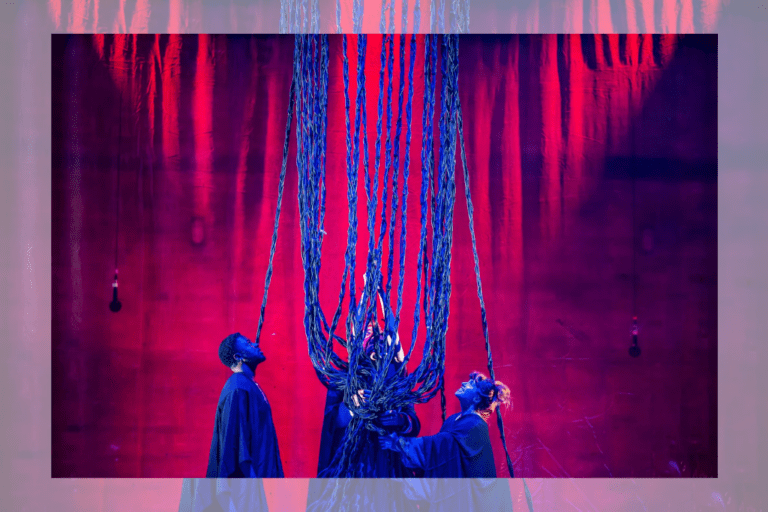 iPhoto caption: Members of the company of 'Medusa.' Photo by Dahlia Katz.
REVIEW: Soulpepper’s Medusa creates a mess it refuses to tidy
Speaking in sibilant murmurs via headsets wired into each seat of the Baillie Theatre, a chorus of intimate voices infiltrates the audience experience, drowning out dialogue and weaving an overstimulating soundscape.
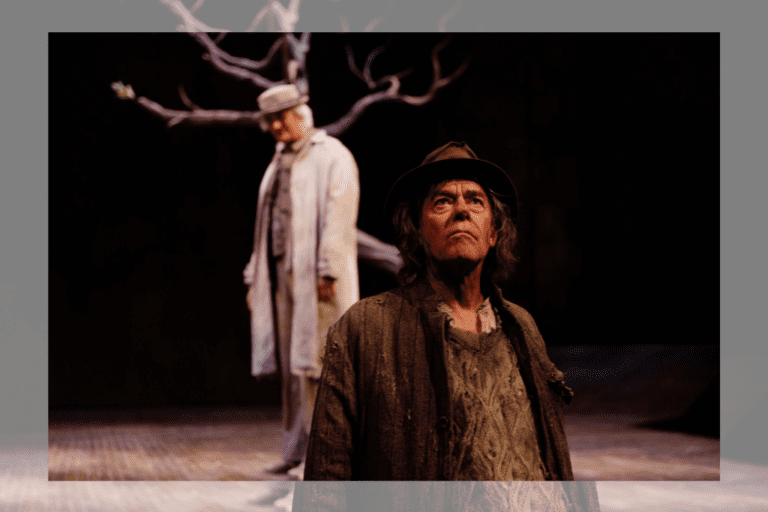 iPhoto caption: Paul Gross and Tom McCamus in 'Waiting for Godot.' Photo by David Hou.
REVIEW: Stratford Festival’s Waiting for Godot never feels fully its own
Tom McCamus' and Paul Gross' performances are clear and intentional. Nonetheless, I struggled to connect with this production.
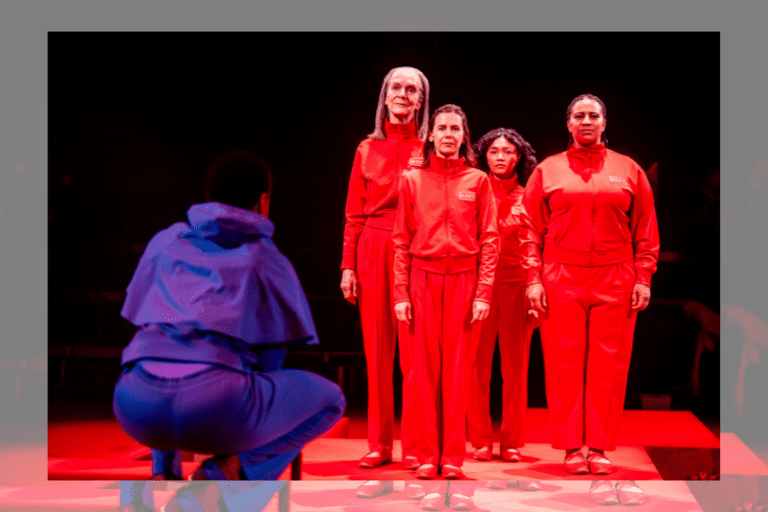 iPhoto caption: Amaka Umeh, Nancy Palk, Michelle Monteith, Belinda Corpuz, and Sabryn Rock in 'Mary, Mary, Mary, Mary.' Photo by Dahlia Katz.
REVIEW: Erin Shields’ Mary, Mary, Mary, Mary is brash, funny, and message-forward
At Crow’s Theatre, Mary, Mary, Mary, Mary is a sensory feast fit for any house of worship. But with so much material, and only 95 minutes, I’m left feeling that the Marys have more yet to say.
 iPhoto caption: William Ellis and members of the company of 'The Herald. Photo by Albert Hoang.
REVIEW: Jill Connell’s The Herald has a lot to say about potential
There’s so much to love about this smart, strange, and achingly lyrical exploration of labour and purpose. Dramaturgical intentionality falters, however, in the details.
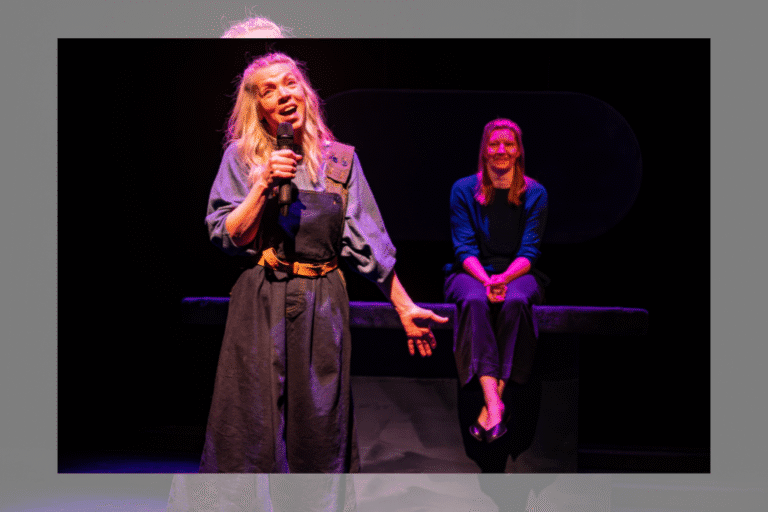 iPhoto caption: Liisa Repo-Martell and Maev Beaty in 'You, Always.' Photo by Dahlia Katz.
REVIEW: In You, Always at Canadian Stage, playfulness meets unabashed emotional vulnerability
This big-hearted play will steal your favourite going-out shirt, holler your crush’s name at full volume, and then accost you with a bear hug — all the while harboring a deep well of love and resentment.
 iPhoto caption: Photo courtesy of Minmar Gaslight.
REVIEW: A Question of Character examines the psychology of a filmmaker who created Nazi propaganda
The greatest strength of A Question of Character, now playing at the Aki Studio, is that its fundamental questions manifest as an active process. Rather than conveying a pre-packaged conclusion, the production undertakes a genuine attempt to work through Leni Riefenstahl's contradictions while weighing the payoffs of revenge.
Comments