
REVIEW: A Question of Character examines the psychology of a filmmaker who created Nazi propaganda
 iPhoto caption: Photo courtesy of Minmar Gaslight.
In A Question of Character, produced by Stakes and Embers and Minmar Gaslight, the banality of evil looks like a sunny apartment. The action of Steven Elliott Jackson’s play unfolds here, in the living room of Leni Riefenstahl (Paula Wing), a character based on the German filmmaker frequently referred to as Hitler’s favourite director. It’s a cosy, congenial space, suited to the intimate dimensions of the Aki Studio but markedly at odds with the play’s disturbing revelations.
Film journalist Paulina (Tanisha Taitt) is on Leni’s turf. She enters the apartment eager to interview the controversial documentarian for a retrospective of her career. Their conversation begins with difficult, if abstract, questions. What does it mean to capture the truth? Is that possible? Or, as Paulina suggests, is the camera necessarily an agent of distortion?
Paulina soon trades philosophizing for particulars, challenging her interview subject to explain her actions. Why were the Jewish artists who worked on your earliest film uncredited, she wants to know. What did you do when people started disappearing under Nazi occupation? Why did you agree to make propaganda films for the Third Reich?
The real Leni Riefenstahl did create propaganda films for the Nazi Party, among other acts unveiled over the course of the play. She also persistently claimed to have been ignorant of the Nazi regime’s actions at the time of her collaborations, rejecting all accusations of complicity.
Leni’s responses to Paulina are frustrating — and familiar. You may have seen similar deflections in a YouTube comment section this week, on any topic related to the rising tide of global fascism. I didn’t know. I was doing what I had to. I was looking after myself first. Wing performs Leni with an amused demeanor and just a tinge of annoyance, making these answers doubly aggravating. Paulina pushes her to acknowledge culpability. Impassive, Leni refills their coffee cups.
A turn occurs soon after — I won’t spoil it. Emotion ramps up, and Paulina’s questions become increasingly personal, a development sensitively embodied by Taitt, who conveys deep and believable distress. As Leni, Wing maintains her composure, appearing unruffled, even entertained.
On one hand, Wing’s performance choices work well. Her glib response to Paulina’s vulnerability is rage-inducing, for both Paulina and the audience. Leni’s refusal to admit wrongdoing, combined with Wing’s relaxed presence, hits a vigilante nerve (bring her to justice!), triggering that crucial but less satisfying query: what is justice?
On the other hand, once Paulina plays her card, there’s a specter of impending violence that should lend the scene a visceral sense of stakes. But with a target impervious to emotion, even fear, this atmosphere of tension dissipates. Much lands on Taitt to self-generate.
That said, Jackson’s writing is well-paced, clever, and nuanced, while Alice Fox Lundy’s direction steers us evenly through power shifts and dramatic beats. The action feels firmly grounded in reality.
Jackson notes in the program that he first encountered Riefenstahl during an undergraduate film class. He was troubled by the problem of reconciling the director’s brilliance with her faults. A gifted artist and technical innovator, yet complicit in Nazi atrocities, Riefenstahl has long been a source of fascination and unease, and the subject of a slew of documentary films, including last year’s Riefenstahl, directed by Andres Veiel.
The greatest strength of A Question of Character, which premiered at the 2025 Hamilton Fringe Festival, is that its fundamental questions manifest as an active process. Rather than conveying a pre-packaged conclusion, the production undertakes a genuine attempt to work through Riefenstahl’s contradictions while weighing the payoffs of revenge. In the first half of the play, we hear Paulina’s genuine admiration for Riefenstahl. “I was a fan of yours,” she admits.
The women touch on, as well, Leni’s status as an aspiring woman filmmaker in the 1930s, and her new interest, underwater photography (this was a real development in Riefenstahl’s later years), with a speech dedicated to the beauty of oceanic life. These are important moments as we pass into the play’s second half, not because they exonerate Leni but because they point to her humanity, even as Paulina urgently entreats her to acknowledge the humanity of those on the other side of her camera lens.
Indeed, the production underscores Leni’s ordinariness. Here, I return to the play’s quotidian setting. Leni wanders the space pre-show, comparing proofs, flipping on a lamp, while sunlight filters through an unseen window, creating patterns on the living room rug (lighting design by Vishmayaa Jeyamoorthy). What luxury to be insulated from atrocity, the play muses. What a shame if someone were to infiltrate the walls of this safe haven.
A Question of Character runs at the Aki Studio until January 25. More information is available here.
Intermission reviews are independent and unrelated to Intermission’s partnered content. Learn more about Intermission’s partnership model here.

Ferron Delcy
Ferron Delcy is pursuing her PhD in early modern literature at the University of Toronto. In 2024, Ferron participated in the New Young Reviewers program facilitated by Toronto Fringe and Intermission. She is a big fan of ghost stories, fog machines, and weird metaphors.
LEARN MOREComments
Leave a Comment
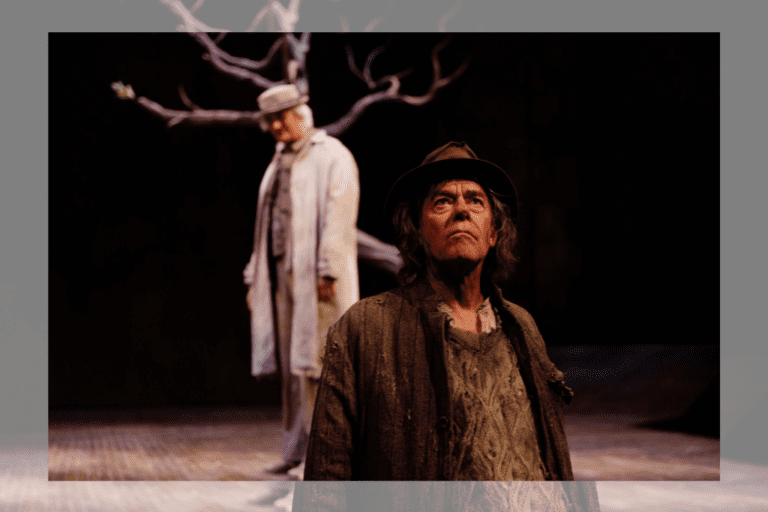 iPhoto caption: Paul Gross and Tom McCamus in 'Waiting for Godot.' Photo by David Hou.
REVIEW: Stratford Festival’s Waiting for Godot never feels fully its own
Tom McCamus' and Paul Gross' performances are clear and intentional. Nonetheless, I struggled to connect with this production.
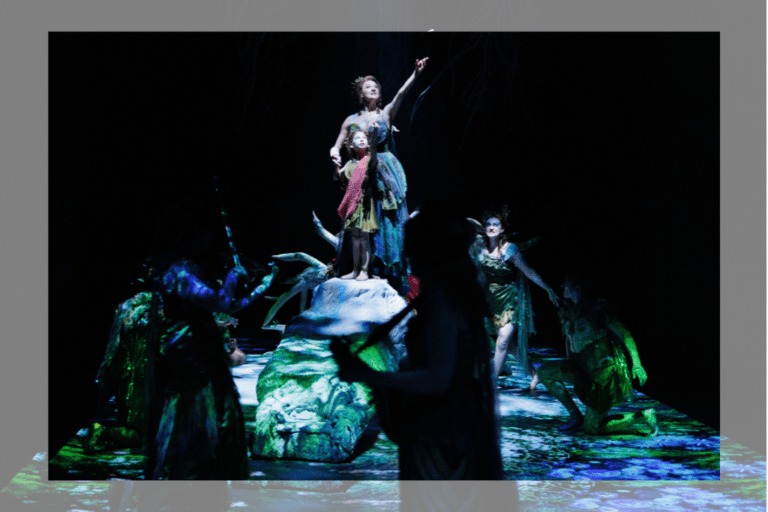 iPhoto caption: Members of the company of 'A Midsummer Night's Dream.' Photo by David Hou.
Developed in collaboration with Groundling Theatre, this A Midsummer Night’s Dream revels in the plights of its love-drugged protagonists through clever clowning, live music, and an animated landscape.
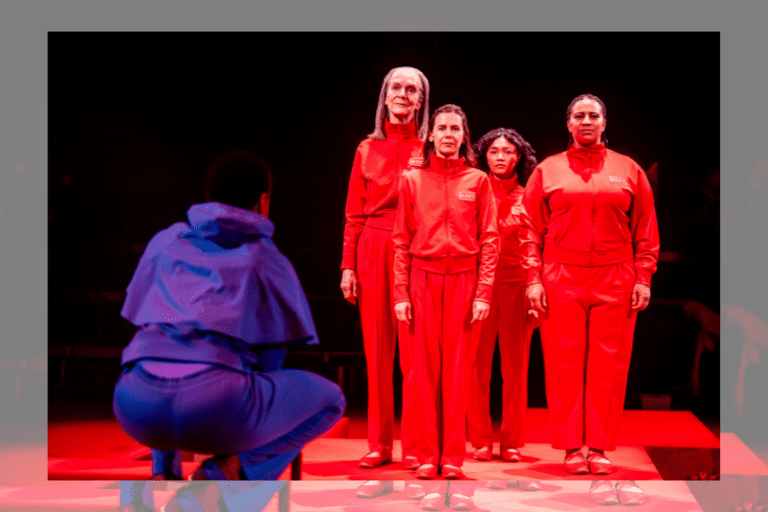 iPhoto caption: Amaka Umeh, Nancy Palk, Michelle Monteith, Belinda Corpuz, and Sabryn Rock in 'Mary, Mary, Mary, Mary.' Photo by Dahlia Katz.
REVIEW: Erin Shields’ Mary, Mary, Mary, Mary is brash, funny, and message-forward
At Crow’s Theatre, Mary, Mary, Mary, Mary is a sensory feast fit for any house of worship. But with so much material, and only 95 minutes, I’m left feeling that the Marys have more yet to say.
 iPhoto caption: William Ellis and members of the company of 'The Herald. Photo by Albert Hoang.
REVIEW: Jill Connell’s The Herald has a lot to say about potential
There’s so much to love about this smart, strange, and achingly lyrical exploration of labour and purpose. Dramaturgical intentionality falters, however, in the details.
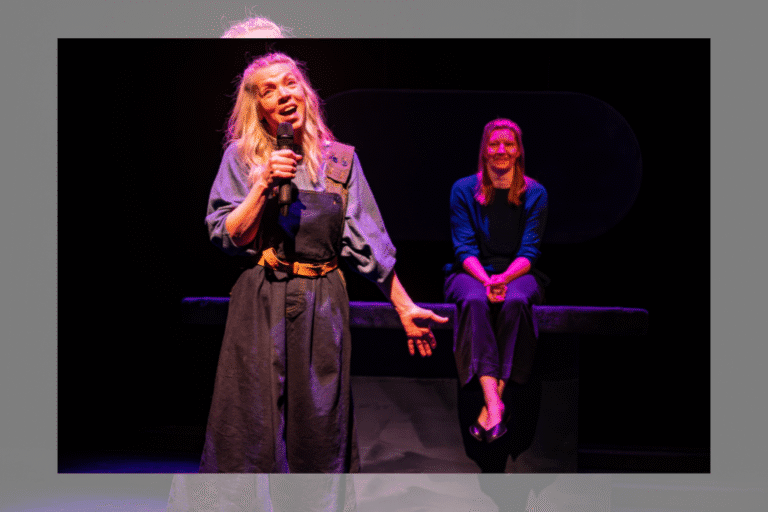 iPhoto caption: Liisa Repo-Martell and Maev Beaty in 'You, Always.' Photo by Dahlia Katz.
REVIEW: In You, Always at Canadian Stage, playfulness meets unabashed emotional vulnerability
This big-hearted play will steal your favourite going-out shirt, holler your crush’s name at full volume, and then accost you with a bear hug — all the while harboring a deep well of love and resentment.
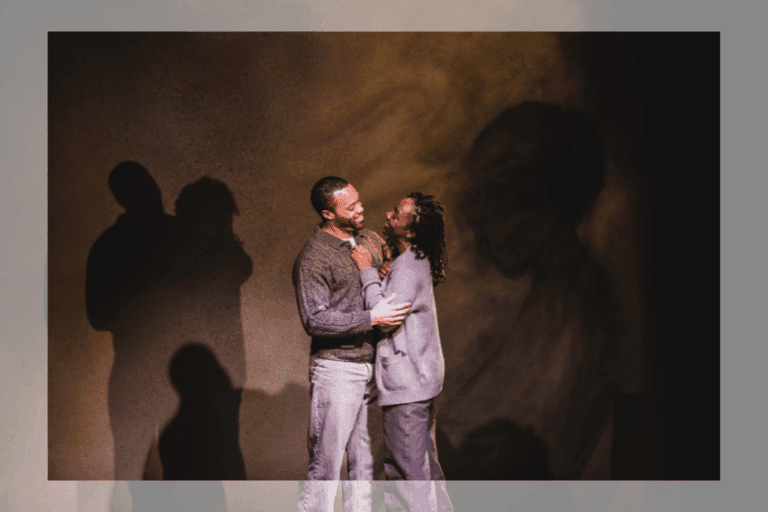 iPhoto caption: Dwain Murphy and Virgilia Griffith in 'a profoundly affectionate, passionate devotion to someone
(-noun).' Photo by Jae Yang.
iPhoto caption: Dwain Murphy and Virgilia Griffith in 'a profoundly affectionate, passionate devotion to someone
(-noun).' Photo by Jae Yang.
REVIEW: Obsidian and Tarragon co-production reflects on the inadequacy of language
a profoundly affectionate, passionate devotion to someone (-noun): the title says it all, offering a definition for an absent word. The thing is the thing unsaid. For the play’s three couples, language falls short: beautifully, tragically, sublimely.
Thank you so much for coming and for the thoughtful review, Ferron. We really appreciate it.