
REVIEW: Tarragon’s CHILD-ish takes a hopeful and hilarious look at life through kids’ eyes
 iPhoto caption: The company of 'CHILD-ish.' Photo by Jae Yang.
Sunny Drake’s CHILD-ish, making its Toronto premiere in the Tarragon Theatre Extraspace, offers a hopeful and hilarious look at life through kids’ eyes, acted by grown-ups. It’s a giggly good time, if a pinch oversweet.
Clad in business casual (costume design by Ming Wong), four actors (Monique Mojica, Janelle Cooper, Karl Ang, and Jordan Pettle) deliver kids’ frank, meandering, silly, and insightful words with complete sincerity. As Andrea Donaldson writes in her director’s note, the show invites us to “see children’s earnest thoughts and impulses from bodies like ours that have been socialized to be ‘grown up.’” Issued by adults, kids’ words gain authority. Speaking kids’ words, the grown-up actors exhibit braveness and vulnerability, breaking the rules of adult self-presentation by saying things like, “Can I take my shoes off? My feet are sweaty.”
Don’t be fooled by the whimsy, however: CHILD-ish was born of a rigorous process of intergenerational collaboration. Drake began conducting interviews with kids in 2017. He suspected young people could help grown-ups understand love in new ways, and planned to use his interviews to create a verbatim play — a style of theatre that incorporates the exact words of real people. But the project quickly expanded beyond Drake’s initial thematic focus. Participants wanted to share their opinions on death, climate change, and inequality. And interview Drake and each other. Oh, and include a song about unicorns.
This journey serves as the plot for CHILD-ish, which ultimately restages the process of its own creation. At one point in the play, a fictionalized Drake (Asher Rose) confesses to embarrassment at forgetting to ask the kids what they wanted to talk about. Happy to follow their lead, Drake (the real and fictional) arranged more interviews and even included kids in the playwriting process as dramaturges. CHILD-ish is much more than its product, modelling a process that values kids’ experiences of life and treats them as genuine artistic partners.
With kid philosophies driving the show, it makes sense that CHILD–ish refuses adherence to a traditional dramatic framework. Drake has structured his play as a series of vignettes, which Rose guides us through with the help of title card projections (designed by Laura Warren). The last third of the play gleefully dives into an audience participation segment and then brings out a child ensemble for the finale, which includes a reading of a Kid Manifesto and a group chicken dance. The energy is joyous and zany and a little like a sugar high.
CHILD-ish has its moments of gravitas as well. The kids talk about serious topics, like breakups and war. These are some of the play’s most poignant moments, when we get to hear monologues detailing personal experiences. One child (Ang) describes a move from Syria, where there are many “ghost friends,” to Canada, where there are not as many swimming pools as promised. Another (Cooper) compares the disappointment of losing a crush’s affection to a toilet breaking. A gender-creative child (Ang) expresses how happy they are when an adult uses their correct pronouns, because it helps them know they have a friend in that adult. In all of these scenarios, what works well is the opportunity to hear a particular child’s perspective on a particular experience, in words that feel honest and unaffected.
Sometimes, I wished there was more of this specificity. Donaldson acknowledges that identities in the play are “intentionally not consistent”: the four actors play over 40 children, ages five to 12. But the effect is something like a composite child who has no age or identity. I wonder if that slightly weakens the project’s commitment to valuing what kids have to say. Specificity in the way of story, thematic focus, or character might have also made the play’s serious messaging more resonant. Without anything to hold onto, important insights and imperatives (“stop being sexist”) risk sounding a little like platitudes.
I’m going to say something blasphemous: I think the web series version of CHILD-ish, created during the pandemic, allows the project’s strengths to shine more brightly by removing the pressure of long-form presentation. That said, as a live experience, audiences can fully appreciate the actors’ sensitive embodiment of kid language and logic. This cast’s deeply felt performances make the trip to Tarragon absolutely worth it.
CHILD-ish runs at Tarragon Theatre until November 16. More information is available here.
Intermission reviews are independent and unrelated to Intermission’s partnered content. Learn more about Intermission’s partnership model here.

Ferron Delcy
Ferron Delcy is pursuing her PhD in early modern literature at the University of Toronto. In 2024, Ferron participated in the New Young Reviewers program facilitated by Toronto Fringe and Intermission. She is a big fan of ghost stories, fog machines, and weird metaphors.
LEARN MORE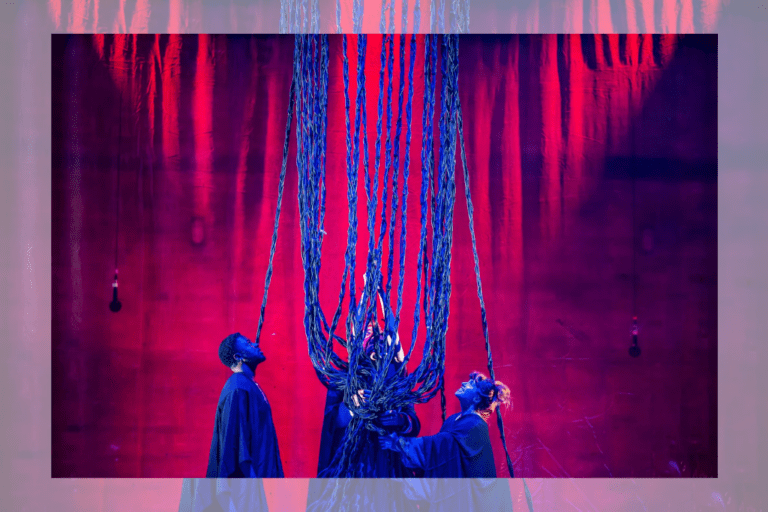 iPhoto caption: Members of the company of 'Medusa.' Photo by Dahlia Katz.
REVIEW: Soulpepper’s Medusa creates a mess it refuses to tidy
Speaking in sibilant murmurs via headsets wired into each seat of the Baillie Theatre, a chorus of intimate voices infiltrates the audience experience, drowning out dialogue and weaving an overstimulating soundscape.
 iPhoto caption: Paul Gross and Tom McCamus in 'Waiting for Godot.' Photo by David Hou.
REVIEW: Stratford Festival’s Waiting for Godot never feels fully its own
Tom McCamus' and Paul Gross' performances are clear and intentional. Nonetheless, I struggled to connect with this production.
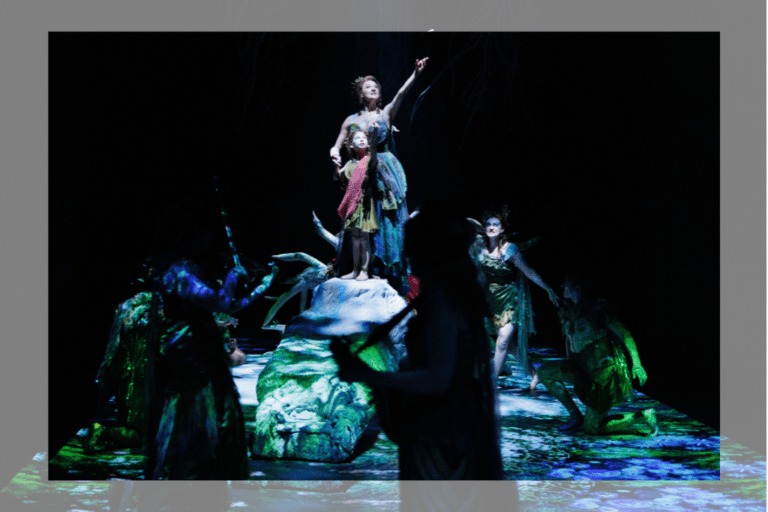 iPhoto caption: Members of the company of 'A Midsummer Night's Dream.' Photo by David Hou.
Developed in collaboration with Groundling Theatre, this A Midsummer Night’s Dream revels in the plights of its love-drugged protagonists through clever clowning, live music, and an animated landscape.
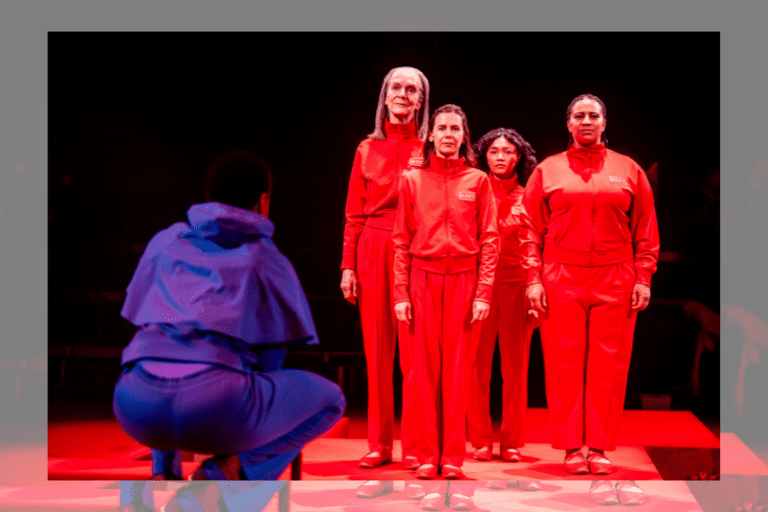 iPhoto caption: Amaka Umeh, Nancy Palk, Michelle Monteith, Belinda Corpuz, and Sabryn Rock in 'Mary, Mary, Mary, Mary.' Photo by Dahlia Katz.
REVIEW: Erin Shields’ Mary, Mary, Mary, Mary is brash, funny, and message-forward
At Crow’s Theatre, Mary, Mary, Mary, Mary is a sensory feast fit for any house of worship. But with so much material, and only 95 minutes, I’m left feeling that the Marys have more yet to say.
 iPhoto caption: William Ellis and members of the company of 'The Herald. Photo by Albert Hoang.
REVIEW: Jill Connell’s The Herald has a lot to say about potential
There’s so much to love about this smart, strange, and achingly lyrical exploration of labour and purpose. Dramaturgical intentionality falters, however, in the details.
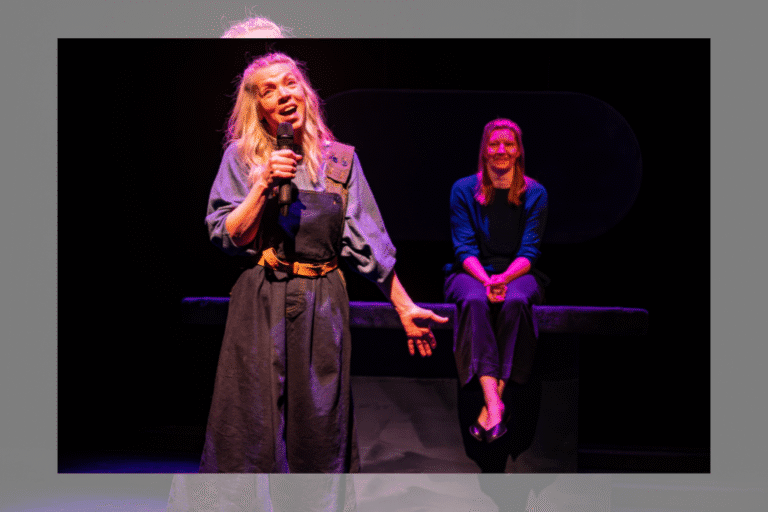 iPhoto caption: Liisa Repo-Martell and Maev Beaty in 'You, Always.' Photo by Dahlia Katz.
REVIEW: In You, Always at Canadian Stage, playfulness meets unabashed emotional vulnerability
This big-hearted play will steal your favourite going-out shirt, holler your crush’s name at full volume, and then accost you with a bear hug — all the while harboring a deep well of love and resentment.
Comments