
REVIEW: Detailed design anchors confident Who’s Afraid of Virginia Woolf? at Canadian Stage
 iPhoto caption: Photo by Dahlia Katz.
For much of Canadian Stage’s new production of Who’s Afraid of Virginia Woolf?, the beloved drama by Edward Albee, a curtain’s bottom-left corner ripples in the wind. As bottles smash, vomit erupts, and books hurl into walls, this piece of white fabric billows on, the wind unaltered by the war of egos ravaging the surrounding New England parlour. It’s an affecting detail in a high-profile production flush with thoughtful design choices. Tasked for the second time in a year with filling the titanic canvas of the Bluma Appel Theatre, director Brendan Healy opts for hundreds of little strokes over a single massive one.
Home from a university faculty party stumble married couple George (Paul Gross) and Martha (Martha Burns), a matter-of-fact assistant history professor and the cunning daughter of the school’s president, respectively. Drunk, they argue about a line from a Bette Davis flick on their centre-stage couch, which faces upstage. But when younger couple Honey (Hailey Gillis) and Nick (Ryan Wilkie) arrive for fun and games, a turntable rotates and the furniture opens itself up to the audience.
As the rest of the play unfolds — Albee’s after-hours plot mostly consists of drinking, flirting, manipulating, and screaming — that turntable doesn’t get a ton more usage. But Healy enriches the visual world of Who’s Afraid of Virginia Woolf? in other ways. Although Julie Fox’s set and costume design evoke the play’s 1960s setting, traces of the surreal poke through. The house’s walls tell a whole story, each side of the open-faced rectangle carrying a different texture: upstage is smudged floral wallpaper, stage right are beige wood planks, and stage left is highly reflective metal. As George, Martha, and Nick wrestle for control, these towering panels pull in distinct aesthetic directions, forming a triangle of their own.
Gross and Burns are married in real life, but this isn’t The Notebook: The Musical. George and Martha spend most of the runtime psychologically torturing each other — while these people need each other deeply, that fact doesn’t assert itself until the play’s final moments, when dawn rises over the party’s carnage. It’s only a romance if you really squint.
As they verbally brawl, Burns’ Martha is the more dynamic of the two, presenting a surface of borderline babyish innocence (“I want a big sloppy kiss!”) before bounding at her prey without reserve. The opening night audience cheered in encouragement as she did jazz kicks down an upstage flight of stairs after changing into tight gold pants.
Gross’ George almost feels like a bitter former hockey player, his scruffy exterior (and boxy, jersey-like cardigan) doing little to shroud his flat excretions of machismo. In most cases, I don’t really notice actors’ ages not matching the script, but Gross being 19 years older than the character’s original age of 46 changes things: While Martha’s jabs at George’s less-than-mountainous status within the university usually seem a bit silly, given that he still has the prime of his academic career ahead of him, they’re rather more brutal aimed at someone nearing retirement.
In a pre-show speech, Healy explained that Mac Fyfe, who was originally cast as Nick, was out of Who’s Afraid of Virginia Woolf? due to medical issues; on opening night, Wilkie, his replacement, had been with the show for just five days, and performed with a period-accurate script in hand (particularly understandable because the show runs three-and-a-half hours including two intermissions). His precise text work and uptight physicality managed to keep the four-hander scenes afloat, but the play’s pair of lengthy scenes between Nick and George dragged, and left the particulars of that relationship muddy.
And while Honey gets the least to do (she spends most of the play blacked out in the bathroom), Gillis gets to explode into a couple ecstatic outbursts of joy that recall her exuberant Nina in Soulpepper Theatre’s 2023 production of The Seagull.
Perhaps oddly for a one-room drama, however, the performances aren’t the most memorable thing about this solid, but not transcendent, production. That’s still the hulking set, which seems almost to have a pulse — the floor spinning under our prizefighters’ feet, the wall shining like a funhouse mirror. It’s a foreboding arena I began to doubt George and Martha would ever leave.
Who’s Afraid of Virginia Woolf? runs at Canadian Stage until February 16. Tickets are available here.
Intermission reviews are independent and unrelated to Intermission’s partnered content. Learn more about Intermission’s partnership model here.

Liam Donovan
Liam is Intermission’s senior editor. He lives in Toronto. His Substack newsletter is available at loamdonovan.substack.com.
LEARN MOREComments
Leave a Comment
 iPhoto caption: 'Documents Perform 3.' Photo by T Photo Factory.
Joining online from across the Americas, more than a dozen artists, artistic producers, cultural leaders, and policymakers add live suggestions to the document, together transforming stuffy bureaucratic language into a rowdy patchwork of compassionate imagining.
 iPhoto caption: Stratford's Tom Patterson Theatre. Photo by Ann Baggley.
2027 highlights include a new Canadian Jacob Two-Two musical and two of the Bard’s thornier plays: The Merchant of Venice and The Taming of the Shrew.
 iPhoto caption: Devon Michael Brown as Rusty Charlie with members of the 'Guys and Dolls' company.
“It's so exhausting, but it's really rewarding when you get to dance so full-out,” says Devon Michael Brown. “You get to use your technique and your training to the fullest extent.”
 iPhoto caption: Ping-Hsiang Wang in 'Retina Maneuver.' Photo by Hang Su.
REVIEW: At this year’s SummerWorks Performance Festival, physical storytelling is central
From a dancer becoming a canine to a shy theatre director practicing his swordsmanship, the shows I’ve seen so far use performers’ bodies to dramatize defiance.
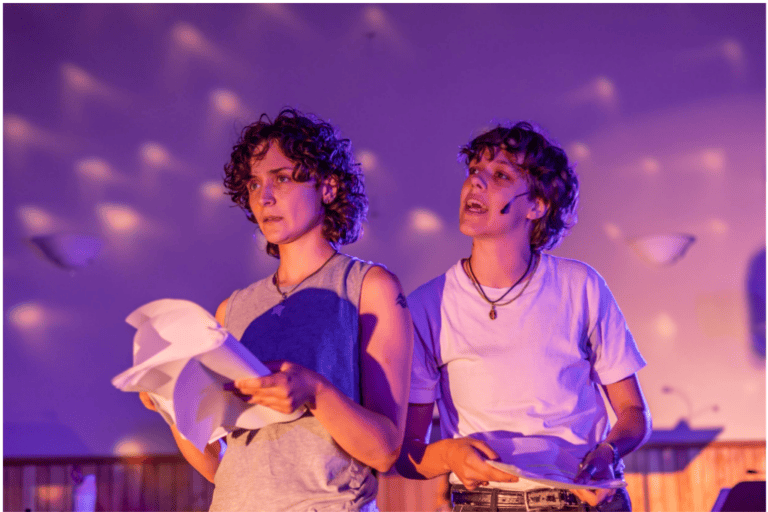 iPhoto caption: Anna Morreale and Luca McPhee perform in 'From Stardust' at the 2025 MADGEN Theatre Festival. Photo by Dave Klassen.
MADGEN Theatre Festival returns to the Danforth
Theatre of the Beat selected four producers under the age of 30 to receive paid mentorship from Toronto theatre-makers. From August 20 to 22, each member of the cohort mounts a new one-act Canadian play.
 iPhoto caption: Steven Sutcliffe and company in 'Twelfth Night.' Photo by Dahlia Katz.
REVIEW: High Park Twelfth Night pays tribute to the crazy things we do for love
As the play’s events ping-pong between seriousness and frivolity, Caroline Toal’s Viola appears constantly aware of the dangerous contradictions in the air, remaining guarded against the chaos' pull — and yet never entirely abandoning the possibility of enchantment.
I saw the show yesterday night. Paul Gross was spectacular !.
One of the finest performances I have ever seen.
I left during the first intermission. The actors were brilliant. The set was cleverly done. The script is unbearable.