
Lighthouse Festival unearths rarely performed Norm Foster one-acts
 iPhoto caption: "My Narrator" photo courtesy of the Lighthouse Festival.
Norm Foster’s plays have long been a pillar of the Lighthouse Festival’s programming, with multiple often appearing in the same season. Usually, that means full-length works — frequently, world premieres. But this summer, the Port Dover/Port Colborne-based company is diving into Foster’s back catalogue and producing a pair of rarely staged one acts from the mid-2000s.
In the spirit of rediscovery, Lighthouse is calling the double bill Hidden Treasures. A single cast performs both of the four-person comedies, and at intermission, Becky Mode’s set completely transforms.
Foster was initially surprised that artistic director Jane Spence wanted to produce the plays — previously paired together in the 2008 collection One-Actmanship — because in his experience Canadian theatres rarely consider shorter works worthy of a full production. “I don’t write many one-act plays,” he told me over Zoom. “They’re not much in demand… Theatres prefer to do the big [ones]. Doing two together is a good idea, because it stretches it to the same [run]time as a regular play.”
Beyond the trouble of getting them produced, Foster noted that one-acts pose unique challenges to him as a writer. “There’s not much time for character development, like there would be in a long play,” he reflected. “You have to… make it satisfying, and to have it come around to a plausible ending. It can’t just be a skit… So, it’s actually a little tougher to write.”
The first half of Hidden Treasures, called “My Narrator,” tells the story of an unlikely romance between Lacy, a down-to-earth painter, and Miles, a socially awkward drifter who meets Lacy while working at his uncle’s clothing store. The twist is that both characters’ inner voices appear onstage as narrators. “You know that voice in your head that tells you ‘don’t do that, don’t do this, you shouldn’t do that,’ and sometimes we listen to it, but sometimes we don’t? That’s what this play is about,” said Foster.
A subplot of “My Narrator” is that Lacy’s narrator, Barb, thinks the artist’s landscape paintings are too lighthearted. “The bright colours, the sunny skies… She thought it was time to try something different,” the narrator says. “Perhaps a darker approach would lend more weight to her work and put her into favour with the critics.”
Foster said this thread about criticism is “absolutely” intended as a wink at the reception to his own early work.
“I used to get a lot that my plays were ‘pedestrian,’” recalls Foster. “I got compared a lot to Neil Simon. I never used to like that. But I mean, Neil Simon is the most successful playwright ever, aside from Shakespeare. Why would I not like to be compared with [him]?… Critics have their own agenda, that doesn’t bother me anymore.”
In Hidden Treasures’ second half, “The Death of Me,” John, a run-of-the-mill young man, appears in heaven after dying from an unexpected aneurysm. His last remarks were uninspiring (“Ah! Ooh! Eee!”), and nobody is likely to find him until the next morning, when his mother makes her routine Saturday visit to his apartment. John discusses these circumstances with the Angel of Death, who does the paperwork for new entrants to heaven. He then tries furiously to “to bargain his way out [and] undo the death,” as Foster put it in our conversation.

Both one-acts depict ordinary people as somewhat beholden to the whims of powerful, unreal figures (though in both cases, the protagonists maintain a degree of agency to advocate for themselves). According to Foster, these sorts of fantastical figures appeal to him because they mean he doesn’t have to worry about logic as much. “You can go anywhere with [the play] when it’s not [only about] a real person,” he said. “It frees me from some of the boundaries you ordinarily have when you write… [Because] who knows what an Angel of Death is like? It makes it easier on me.
“I’m always looking for easy ways to do things,” he jokingly continued. “I’m not a hard worker… Any of my high school teachers will tell you that.”
Self-deprecation aside, Foster is constantly working (he’s long been called “Canada’s most produced playwright”) — and Spence’s idea of Hidden Treasures has inspired him to start thinking seriously about one-acts again.
“After she did that, I [wrote] two Christmas-themed plays… and I put these two together in a collection to try to sell them to theatres for Christmas time,” he said. “So I’m glad that Jane put these two plays together.
“It was a great idea.”
Hidden Treasures runs in Port Dover until July 26, and in Port Colborne from July 30 to August 10. Tickets are available here.
The Lighthouse Festival is an Intermission partner. Learn more about Intermission’s partnership model here.
 iPhoto caption: Photo by Fabian Hammerl.
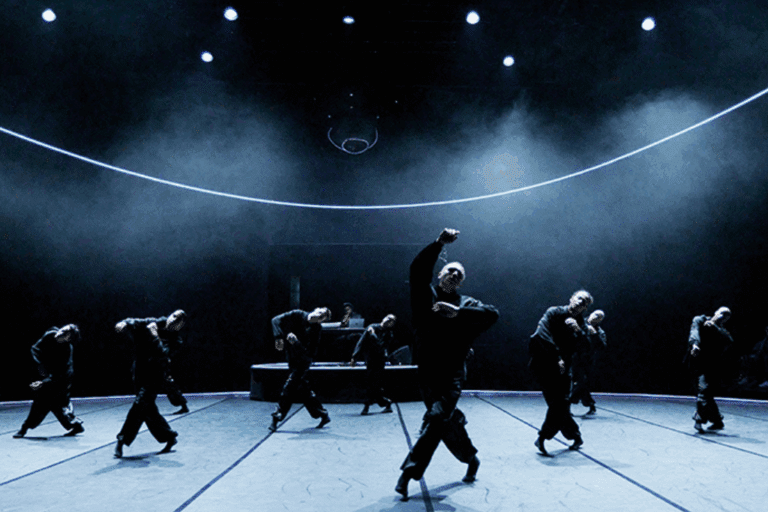
In A a | a B : B E N D, choreographer Aszure Barton aims to rebuild dance from the inside out
“It’s so easy to over-intellectualize dance in general, but B E N D is about hearing and moving to cool-ass music together,” says Barton ahead of the show's run at the Bluma Appel Theatre.
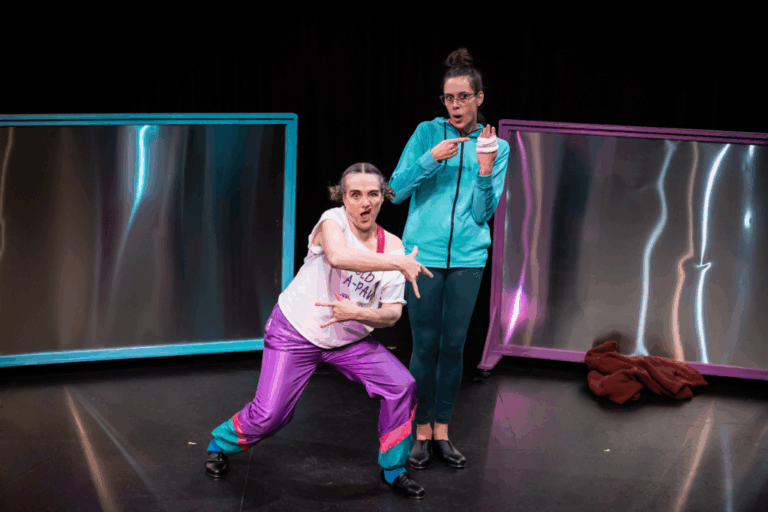 iPhoto caption: Elinor Holt and Ellen Close in 'How Patty and Joanne Won High Gold at the Grand Christmas Cup Winter Dance Competition.' Photo by Benjamin Laird.
“We’re living in a world right now where failure is not an option,” says actor Elinor Holt. “And a lot of times people would rather not try anything at all, rather than try something and risk failing at it.”
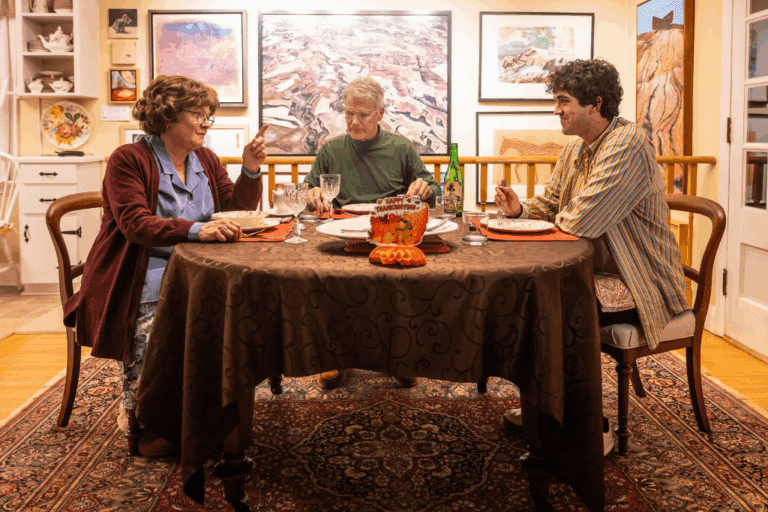 iPhoto caption: Jane Spidell as Bettye, Kevin Bundy as Jim, and Noah Beemer as Steve in 'Twelve Dinners.' Photo by Dahlia Katz.
With TIFT’s Twelve Dinners, actor Steve Ross makes the leap to playwright-director
"I love sitting with the actors before rehearsals and discussing, especially when they ask questions,” says Ross. “I love the blocking and staging. I love directing my own work, but find it challenging."
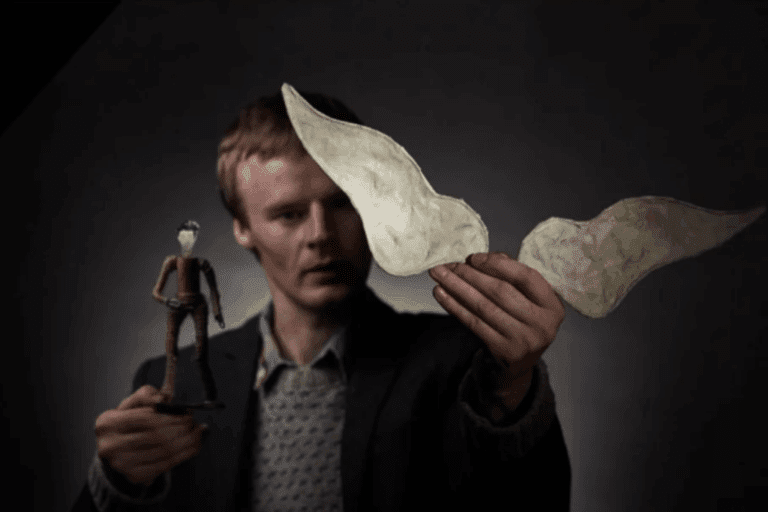 iPhoto caption: Manus Halligan in Dan Colley's adaptation of 'A Very Old Man with Enormous Wings'. Photo by Ste Murray.
A contemporary Gabriel García Márquez adaptation touches down in Toronto
A Very Old Man with Enormous Wings has toured internationally since 2022, with a shifting cast of performers. Halligan and Beaman, the original actors and co-adaptors, will reprise their roles for the Toronto premiere.
 iPhoto caption: 'Narnia' in rehearsal. Photo by Dahlia Katz.
"What emerged for us was this idea of life cycles,” reflects Narnia adaptor-director Fiona Sauder. “‘What happens when you get stuck in one season [of life], and what happens when that season comes to an end? [What things] have to die and fall away in order for new things to grow?’”
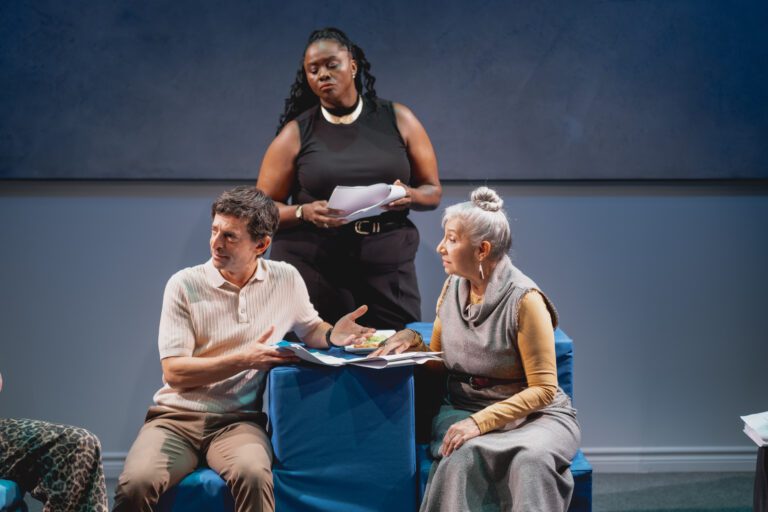 iPhoto caption: Jordan Pettle, Janelle Cooper, and Monique Mojica in CHILD-ish. Photo by Jae Yang.
Tarragon’s upcoming show gives audiences a verbatim taste of children’s wisdom, wit, and weirdness
The first inklings of CHILD-ish came to Drake in 2017. “I got to an age where I started having a lot more kids in my life,” he said. That “got me curious about what adults can learn from kids: playing with and flipping that power dynamic of who’s the learner and who’s the teacher.”
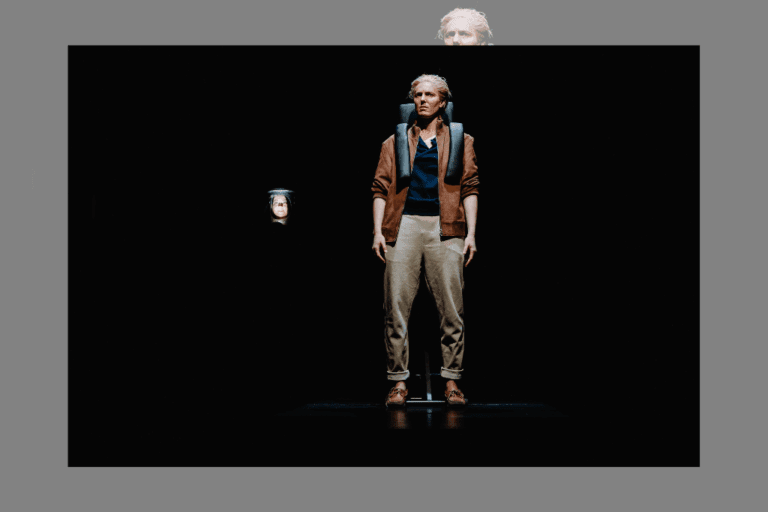 iPhoto caption: Lauren Gillis and Alaine Hutton in 'Public Consumption.' Photo by Eden Graham.
REVIEW: Lester Trips’ stylish Public Consumption captures the internet’s profound emptiness
Rather than directly representing online life, Public Consumption speculates — with virtuosity — about how the digital world affects our bodies. And the show's findings are by no means comfortable.
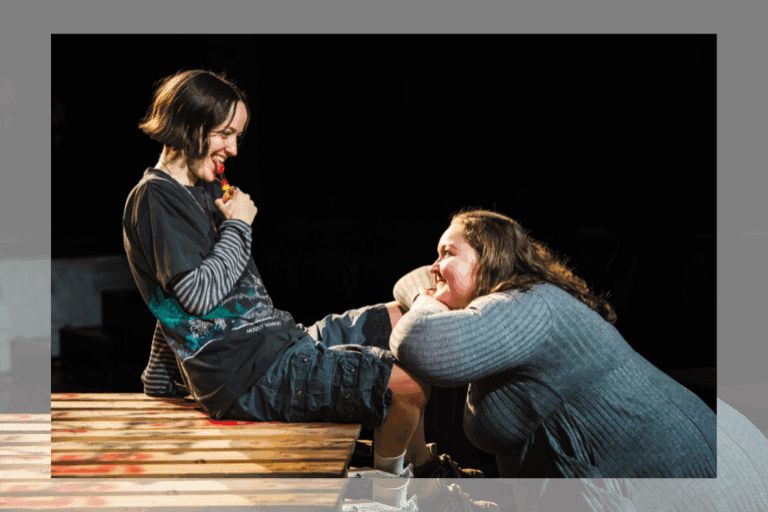 iPhoto caption: Photo by Elana Emer.
REVIEW: Icarus Theatre’s DNA paints a disturbing mural of teenage rebellion
While director Erik Richards’ tendency toward snappy, thriller-esque pacing doesn’t suit all of DNA’s more intimate moments, it adds electricity to the drama’s group scenes, bringing playwright Dennis Kelly’s reflections on groupthink and collective grief into clear view.
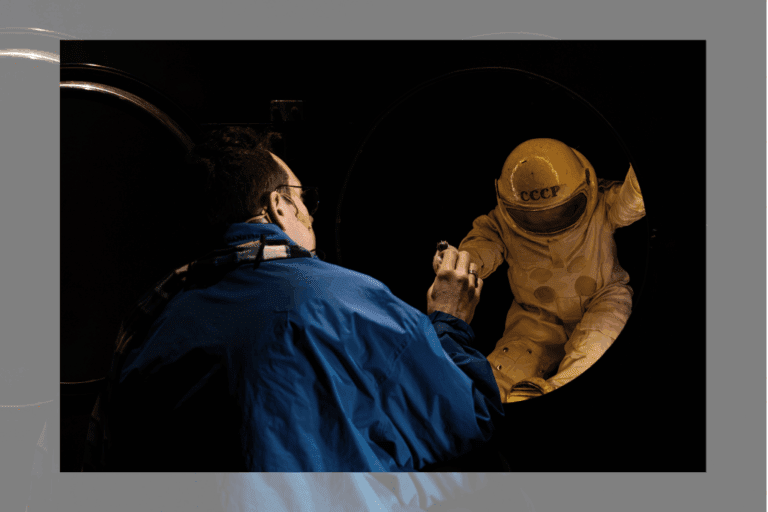 iPhoto caption: Olivier Normand in 'The Far Side of the Moon.' Photo by Li Wang.
REVIEW: Lepage’s ethereal The Far Side of the Moon is insomniac theatre
The Far Side of the Moon begins and ends with a large mirror on stage, and the show extracts enigmatic power from the tantalizing question of whether its protagonist is losing himself in his reflection, or moving toward self-discovery.
 iPhoto caption: 'Kokuho' still courtesy of TIFF.
REVIEW: During this year’s TIFF, two films depicted theatre as a vessel for transcendence
Of the several performing arts-adjacent selections I took in, most affecting were two dramas: Lee Sang-il’s Kokuho and Chloé Zhao’s Hamnet. In both period pieces, theatre creation serves as an emotional outlet for an artist navigating devastating loss.
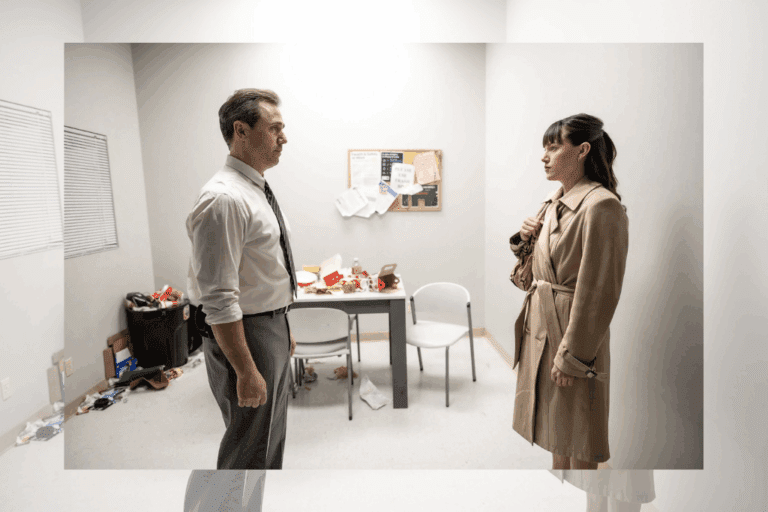 iPhoto caption: Cyrus Lane and Kirstyn Russelle in Barrie run of 'Blackbird.' Photo by Dahlia Katz.
REVIEW: Talk is Free Theatre’s Blackbird offers a close-up look at two detailed performances
Emerging director Dean Deffett has concocted a tight, straightforward production, primarily of interest as an intimate character study.
 iPhoto caption: Sleman Aldib and an audience member in 'The Opposite.' Still from a trailer by Spectrum Associates.
REVIEW: Kitchener’s biennial IMPACT Festival crackled with urgency
Most of the six works I viewed tackled urgent topics, from the convoluted Canadian immigration system to the Palestinian experience of displacement: explorations that line up with artistic director Pam Patel’s curatorial statement, which discusses how IMPACT ‘25 “unpacks what it means to survive, to resist, and to seek refuge” through a global, Indigenous-focused lens.
Comments