
REVIEW: COC’s Bluebeard’s Castle/Erwartung is a hypnotic exploration of light
 iPhoto caption: Christian Van Horn and Karen Cargill in 'Bluebeard's Castle.'
Bluebeard’s Castle/Erwartung, a pairing of one-act operas from the first quarter of the 20th century, is a foundational brick in the Canadian Opera Company’s repertoire: the Robert Lepage-directed double bill has played Toronto several times since its acclaimed 1993 premiere, and has toured to multiple continents.
It was my first time experiencing the show, so I can’t speak to how the iteration onstage at the Four Seasons Centre for the Arts compares to versions past. Still, it was a rich experience. In Bluebeard’s Castle, composed by Béla Bartók, soprano Karen Cargill and bass-baritone Christian Van Horn — the only singers — wryly interweave legerity and heft; despite octaves of separation, their voices end up feeling disarmingly close in spirit.
And while Arnold Schoenberg’s 30-minute monodrama Erwartung mostly plays like an epilogue to the imposing, doubly long Bluebeard’s Castle, soprano Anna Gabler floats hauntingly through its dense forest of dissonance. Johannes Debus leads the polished-as-ever COC Orchestra with confidence; revival director François Racine ably maneuvers the singers (and a handful of wordless actors) through Michael Levine’s grim sets.
Over the decades, Lepage’s production has received many reviews, including several in Toronto’s legacy papers, not to mention a couple in the New York Times and the New Yorker. Rather than retread the ground of an overall analysis, I’d like to zoom in on an element that particularly interested me: Simonovitch Prize-winning designer Robert Thomson’s expressionistic lighting for Bluebeard’s Castle, which nicely enriches the opera’s ambiguous psychological landscape.
Bluebeard’s Castle opens with the sight of a miniature castle rotating in a void of darkness. The petite fortress exudes a storybook quality — a weightlessness at first glance odd, given the violence of the narrative to come. What’s curious is that when the same image returns to conclude the opera, it’s loaded with a great deal more meaning. The power of Lepage, Levine, and Thomson’s visual approach lies in this transformation. They prepare the audience to see an identical object anew.
The rest of the show unfolds in a single, raked hallway, with a dungeon-like door barring the sole, upstage entrance. Béla Balázs’ Hungarian-language libretto, here surtitled in English and French, concerns one of the most messed up house tours I’ve ever witnessed: the titular Bluebeard invites his new wife Judith to his castle, and she demands the keys to a row of seven locked doors, behind which lurk violent secrets.
Judith says she wants to let light into Bluebeard’s gloomy castle, and Lepage makes the space oppressively dark, aside from the doors’ keyholes; through them, white light beams from stage right to the hallway’s opposite wall.
Each door opens to release a burst of illumination that’s different in colour and/or pattern from the keyholes’ neutral glow. A torture chamber spews a cloud of noxious green. An armoury judders out a flash of white squares. A vault crackles like a campfire.
The fourth door guards a garden, matching its green, branch-patterned rectangle of light with a gust of petals and a translucent front projection of trees. (Media effects design is by Laurie-Shawn Borzovoy.) The next is more metaphysical; projections display a galactic image of Earth as Bluebeard introduces his all-powerful kingdom. And then arrives the ominous visual sparseness of a gentle rippling lake, which magnifies the spouses’ shadows against the wall.
The final unlocking dunks the stage in a sea of blood. Out march three women: undead incarnations of wives Bluebeard has murdered. On a platform slightly below floor level, they trudge through a wash of dark crimson, their feet cut off from the view of my seat in the orchestra section. Bluebeard explains that the zombie trio represents dawn, midday, and dusk — before inviting Judith to embody night. She accepts her fate without much struggle.
In this stygian rat trap, it’s striking that the ostensibly light-loving Judith becomes synonymous with darkness. Creepier still, Cargill plays the character with a knowing affect, communicated through a ravenously jagged physicality; the sight of bloodstains in the early chambers only makes her more desperate to complete her descent.
Here, the production’s exploration of light collides with the libretto’s explicit subject matter of conjugal violence. How should we interpret the fact that Judith seems to enjoy her path toward zombified subjugation? This is a dour opera, and most of the obvious readings are depressing: perhaps in Judith’s world, the might of the patriarchy is so all-encompassing that the opportunity to become an undead queen seems a welcome escape. But as the doors open, Thomson’s lighting gestures toward so many different aesthetics — so many different ways of seeing, being — that I find myself wanting to shun the notion that Judith would be willing to subsume herself into Bluebeard’s empire; the contented way she stares at light underlines that she’s familiar with less bloody approaches to life. So is it all possible that she’s entering the afterlife with renegade intentions? That she’s travelling to the underworld with the aim of letting in the light?
I realize I’m projecting contemporary values onto an early-20th-century libretto. But so, perhaps, are Lepage and Thomson. In any case, when the opening image returns as a bookend, it’s no longer the rotating model that interests me, but the surrounding sea of darkness, which now seems to represent our maybe-revolutionary queen of the night: filling the stage, dwarfing the miniature castle, presaging Thomson’s final blackout.
Bluebeard’s Castle/Erwartung runs at the Four Season Centre for the Arts until May 16. More information is available here.
Intermission reviews are independent and unrelated to Intermission’s partnered content. Learn more about Intermission’s partnership model here.
Liam Donovan
Liam is Intermission’s senior editor. He lives in Toronto. His Substack newsletter is available at loamdonovan.substack.com.
LEARN MORE iPhoto caption: Steven Sutcliffe and company in 'Twelfth Night.' Photo by Dahlia Katz.
REVIEW: High Park Twelfth Night pays tribute to the crazy things we do for love
As the play’s events ping-pong between seriousness and frivolity, Caroline Toal’s Viola appears constantly aware of the dangerous contradictions in the air, remaining guarded against the chaos' pull — and yet never entirely abandoning the possibility of enchantment.
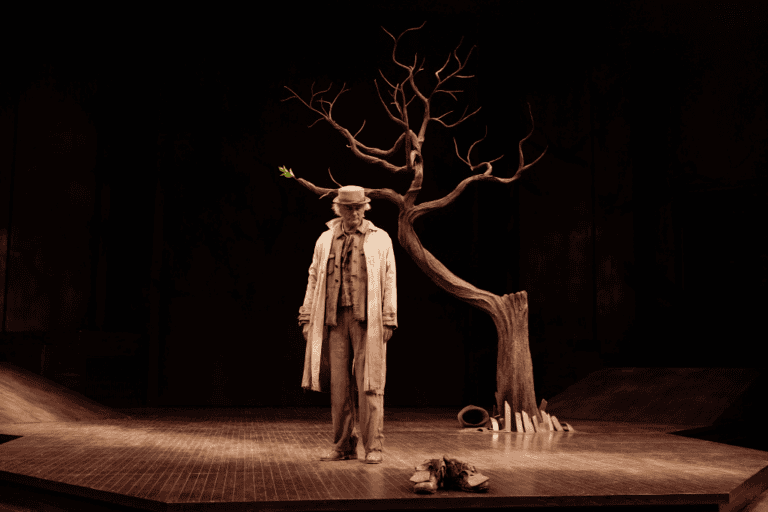 iPhoto caption: Paul Gross in 'Waiting for Godot.' Photo by David Hou.
Why Paul Gross thinks Waiting for Godot is ‘one of the great achievements of human creativity’
“The audience is with you. You bring them in. There isn't a big division between the stage and the audience,” says Gross, currently playing Vladimir in Waiting for Godot at the Stratford Festival. “They’re the final piece of the storytelling. We need them to complete the circle.”
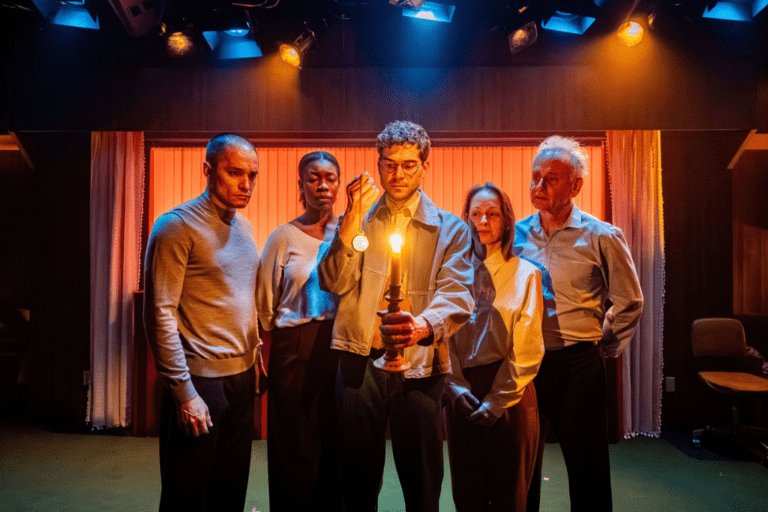 iPhoto caption: Karl Ang, Ivy Charles, Daniel Maslany, Mariya Khomutova, and Alon Nashman in 'The Division.' Photo by Dahlia Katz.
Productions at Crow’s and Theatre Passe Muraille win top honours at the 2026 Dora Awards
This evening at Meridian Hall, the Toronto Alliance for the Performing Arts (TAPA) announced the recipients of the 46th annual Dora Awards, celebrating local theatre, dance, and opera.
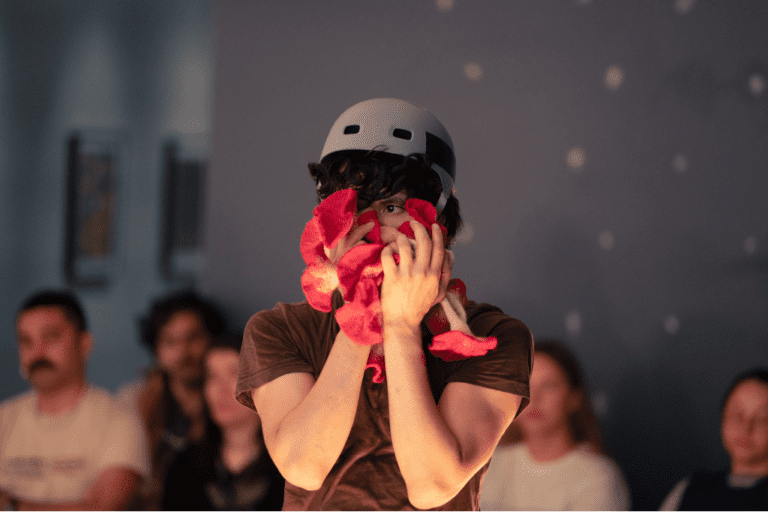 iPhoto caption: 'Golden Rez Dog.' Photo by Philippe Latour.
Creations from Denmark, Hong Kong, Iran, Mexico, and beyond feature in this year’s SummerWorks Performance Festival programming.
 iPhoto caption: Photo by Drew Berry.
REVIEW: An homage to Richard Foreman commands us to change our lives — and our theatre
Richard Foreman's plays usually drew on his personal journals and clocked in around 70 minutes; when he passed away last year at the age of 87, he left behind an invitation for directors to create royalty-free work from those journals. With the recently closed You Must Change Your Life at Toronto’s Alumnae Theatre, creator-director Ilana Khanin took up that offer to ludic, collage-like effect.
 iPhoto caption: Danny O’Mahony and Emily Kilkenny Roddy in 'Bellow.' Photo by Ste Murray.
REVIEW: This year’s Bealtaine Theatre Festival featured accordions, ketamine, and James Joyce
The festival serves up a curated program of contemporary theatre from Ireland — appreciated, in a city that punches below its weight in terms of international performing arts offerings from countries it doesn’t border.
Comments